
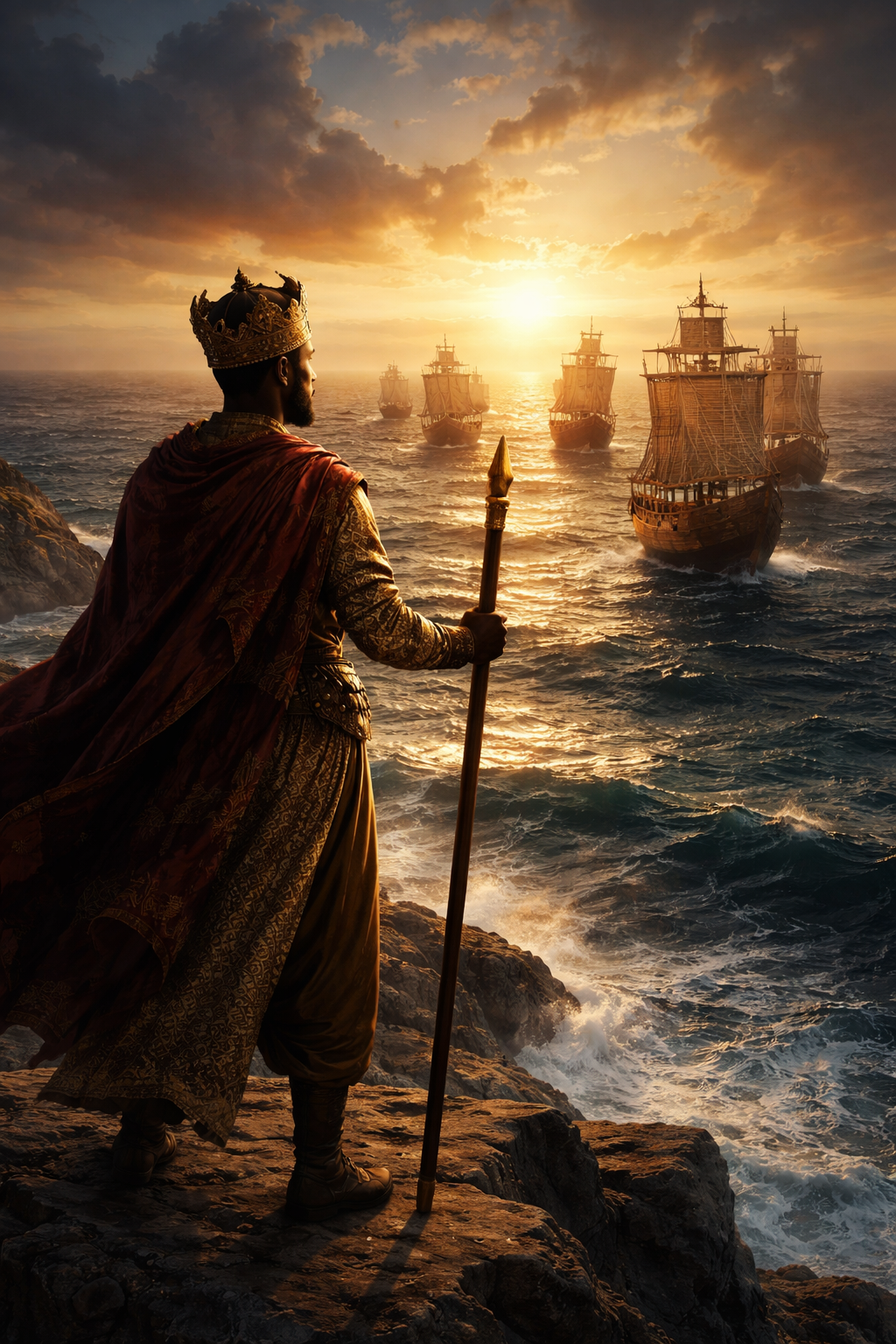
The Emperor Who Refused to Believe the World Ended
The Atlantic horizon has a way of swallowing certainty. In the early 14th century, the Mali Empire stood among the wealthiest civilizations on Earth. Gold from its lands shaped global economies, scholars flourished, and trade stretched across continents.
And yet, one ruler stared west and wondered:
What lies beyond?
His name was Abubakari II.
And he did something almost unimaginable. He gave up the throne — willingly — to sail into the Atlantic Ocean. Not for war. Not for conquest. But for discovery.
The Story That Survived in Cairo
Years later, during the famous pilgrimage of Mansa Musa, a remarkable account was recorded by historian Al-Umari in Cairo.
Mansa Musa explained that his predecessor had launched an Atlantic expedition with hundreds of ships. Only one returned from the first voyage. The crew described a powerful current pulling vessels westward into the unknown.
Unsatisfied with that report, Abubakari II prepared a second fleet. This time, he led it himself. The ships vanished. The emperor vanished. The ocean kept its silence.
Did Abubakari II Reach America Before Columbus?
This question has grown louder in recent years: Did Abubakari II reach America before Christopher Columbus?
More than 150 years later, Christopher Columbus sailed west and returned — changing global history forever. But what if someone else made the journey first… and never came back to tell the story?
Oceanographers confirm that Atlantic currents naturally flow from West Africa toward the Americas. A vessel caught in the right current could, in theory, reach South America.
The route existed. The ambition existed. The disappearance remains.
The Chilling Possibilities
If Abubakari II reached the Americas, what happened next?
- Did the fleet land and integrate with Indigenous communities?
- Did storms scatter the ships across the Caribbean?
- Did they perish at sea?
- Did they reach the Americas but fail to return against powerful currents?
The theory of pre-Columbian African contact with the Americas remains controversial because physical evidence is limited.
- No confirmed Malian artifacts in pre-Columbian archaeological layers
- No preserved Malian ships
- No definitive inscriptions
Yet the absence of evidence does not erase the mystery. Oceans rarely preserve wooden fleets for seven centuries.
Why History Remembers Columbus — But Not Abubakari
History favors survivors. Columbus returned, documented his voyages, reported to monarchs, and secured funding for more expeditions.
Abubakari II, if he reached America, did none of those things. Exploration without return becomes legend, and legend often fades into footnotes.
But as global narratives are revisited, the question refuses to disappear.
A Risk No Emperor Was Expected to Take
Imagine ruling one of the richest empires in medieval history. Imagine having absolute authority — and still choosing to abandon power for uncertainty.
Even if the fleet never reached America, the decision itself reveals a civilization curious enough to look beyond its known world.
- It challenges outdated assumptions about medieval Africa.
- It forces a rethinking of African maritime capability.
- It raises a deeper question: How many voyages were lost simply because no one returned?
The Ocean Keeps Its Secrets
The Atlantic has swallowed countless ships. Storms erase wood. Salt dissolves iron. Time buries stories.
Some voyages reshape the world because they return with proof. Others vanish, leaving only echoes in historical records.
Did Abubakari II disappear in America? Did he die at sea? Did he witness shores that Europe would not see for another century?
No definitive evidence answers these questions. But the mystery continues to pull historians and curious minds back to the moment when an emperor looked west — and refused to believe the world ended there.
What Do You Think?
Could an African emperor have crossed the Atlantic before Columbus? Or is this one of history's most compelling unresolved legends?
Share your thoughts.


