
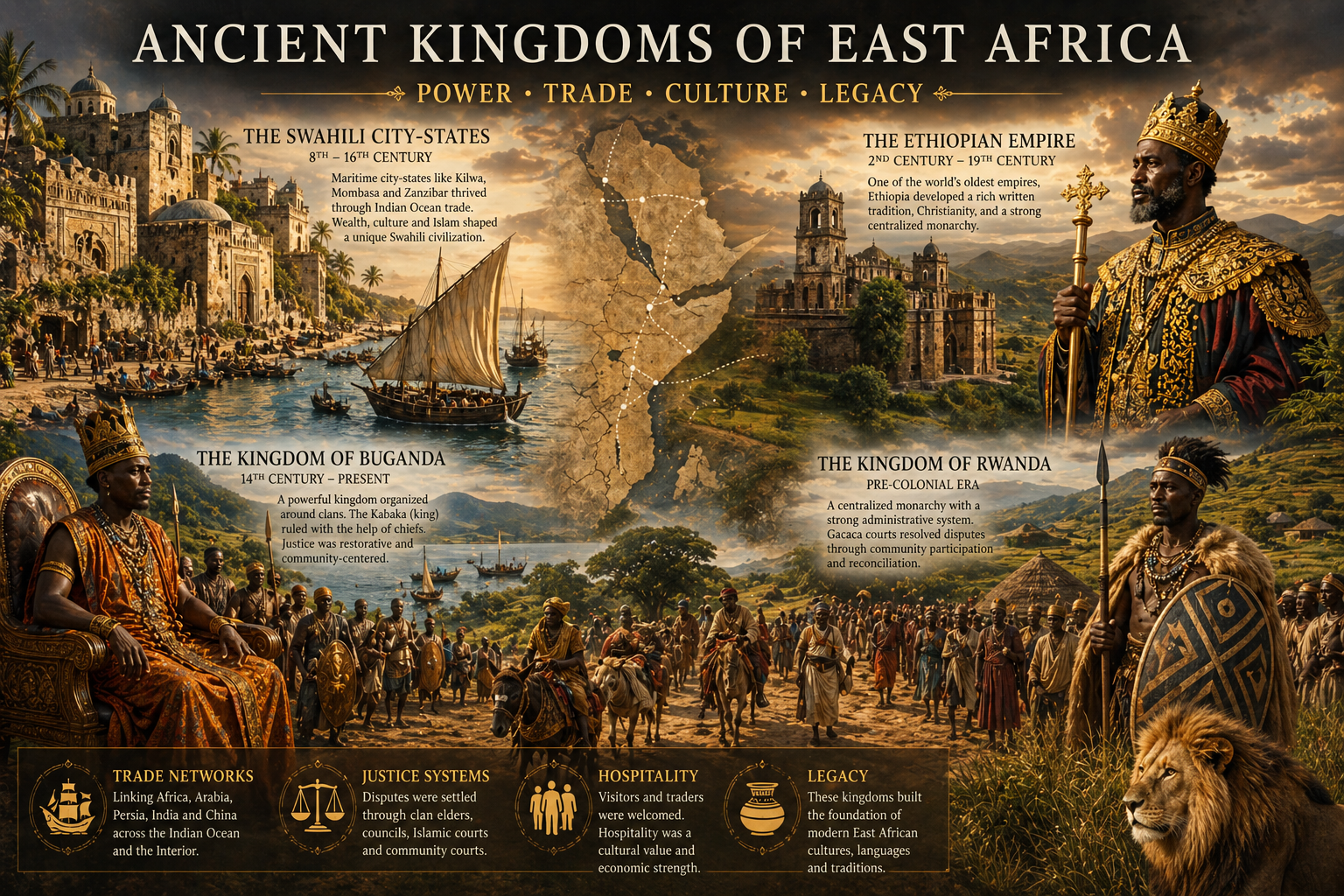
Before Borders, There Were Kingdoms
Before Kenya, Uganda, Tanzania, Rwanda, and Ethiopia existed as modern nations, East Africa was home to powerful kingdoms, maritime city-states, and sophisticated societies connected by trade routes stretching across the Indian Ocean and deep into Central Africa.
This region was never isolated. It was a crossroads.
Arab traders sailed in with monsoon winds. Caravans crossed savannah and forest carrying gold, ivory, salt, and iron. Inland kingdoms developed complex political systems, legal traditions, and cultural identities long before European colonization reshaped the region.
Understanding the ancient kingdoms of East Africa helps explain the cultural, political, and social foundations of the region today.
The Geography That Shaped Civilization
East Africa’s kingdoms developed around three major zones:
- The Indian Ocean coast (trade and maritime cities)
- The Great Lakes region (agriculture and centralized monarchies)
- The Ethiopian highlands (imperial states and early written law)
Each zone produced distinct forms of governance and culture.
The Swahili City-States: Maritime Kingdoms of the Coast
The Rise of the Swahili Civilization
From roughly the 8th to 16th centuries, a chain of wealthy city-states emerged along the East African coastline. These cities were part of the Indian Ocean trade network connecting Africa, Arabia, Persia, India, and China.
Major Swahili cities included Kilwa, Mombasa, Malindi, Lamu, and Zanzibar.
These were not colonies or settlements. They were African city-states shaped by global trade.
Who Ruled the Swahili Coast?
The Swahili people emerged from the mixing of:
- Bantu coastal communities
- Arab traders
- Persian merchants
Over time, this created a distinct culture, language (Swahili), and urban society.
Leadership typically centered around:
- Sultans
- Merchant elites
- Religious scholars
Power was strongly tied to trade wealth.
Political Organization
- Each city governed itself
- Merchant councils influenced decisions
- Islamic law guided courts
- Wealth determined political influence
Kilwa became the most powerful among them due to its control of the gold trade from the interior.
Justice and Dispute Resolution
Justice blended Islamic law (Sharia), local customs, and merchant arbitration. Courts handled trade disagreements, inheritance, and family law.
Treatment of Strangers
Foreign traders were welcomed because they brought wealth. Visitors were given lodging, offered trade partnerships, and integrated into commercial life. Hospitality was economic strategy.
The Ethiopian Empire: A Highland Superpower
One of the World’s Oldest Kingdoms
The Ethiopian Empire stands as one of the longest-lasting states in history, with roots tracing back over 2,000 years.
Unlike most African kingdoms, Ethiopia developed:
- Written law
- Organized Christianity
- Diplomatic ties with Europe and the Middle East
Peoples of the Empire
- Amhara
- Tigray
- Oromo
- Afar
- Agaw
It functioned as a multi-ethnic empire long before modern nation-states.
Political Structure
- Emperor (Negus Negast)
- Nobility and regional governors
- Military commanders
- Village leaders
The Fetha Nagast Legal Code
The Fetha Nagast covered property rights, marriage, inheritance, crime, punishment, and religious law.
Foreign Relations
Ethiopia maintained diplomatic relations with the Middle East, Europe, and India.
The Kingdom of Buganda: Power on Lake Victoria
Rise of the Baganda
Buganda became one of the most powerful kingdoms in the Great Lakes region. Society was organized around clans.
Political Organization
- Kabaka (King)
- Prime Minister (Katikkiro)
- Regional Chiefs
- Clan Leaders
Justice System
- Family mediation
- Clan elders
- Chiefs’ courts
- King’s court
The goal was restoring harmony, not punishment.
The Kingdom of Bunyoro-Kitara: The Rival Power
The Banyoro controlled iron production, trade routes, and agricultural lands. The Omukama ruled through regional chiefs and managed long-distance trade networks.
The Kingdom of Rwanda: Centralized Monarchy
Social Structure
- Tutsi (pastoralists)
- Hutu (farmers)
- Twa (hunter-gatherers)
Governance
The Mwami ruled through chiefs of land, cattle, and military leaders.
Gacaca Justice System
Community courts used public testimony, participation, and restorative justice.
Trade Networks of East Africa
Trade routes linked the interior, Great Lakes, and coastal markets, forming an early global economy.
Common Values Across East African Kingdoms
- Layered leadership
- Restorative justice
- Hospitality culture
- Trade as lifeblood
The Impact of Colonial Borders
European colonization disrupted trade routes, political systems, and cultural networks. Yet their influence continues to shape modern East Africa.
Final Thoughts
Before colonial borders, East Africa was a landscape of organized kingdoms, thriving trade networks, and sophisticated governance systems. These civilizations were complex and their legacy lives on today.


