
Inside the secret world of Kenya's miraa pilots
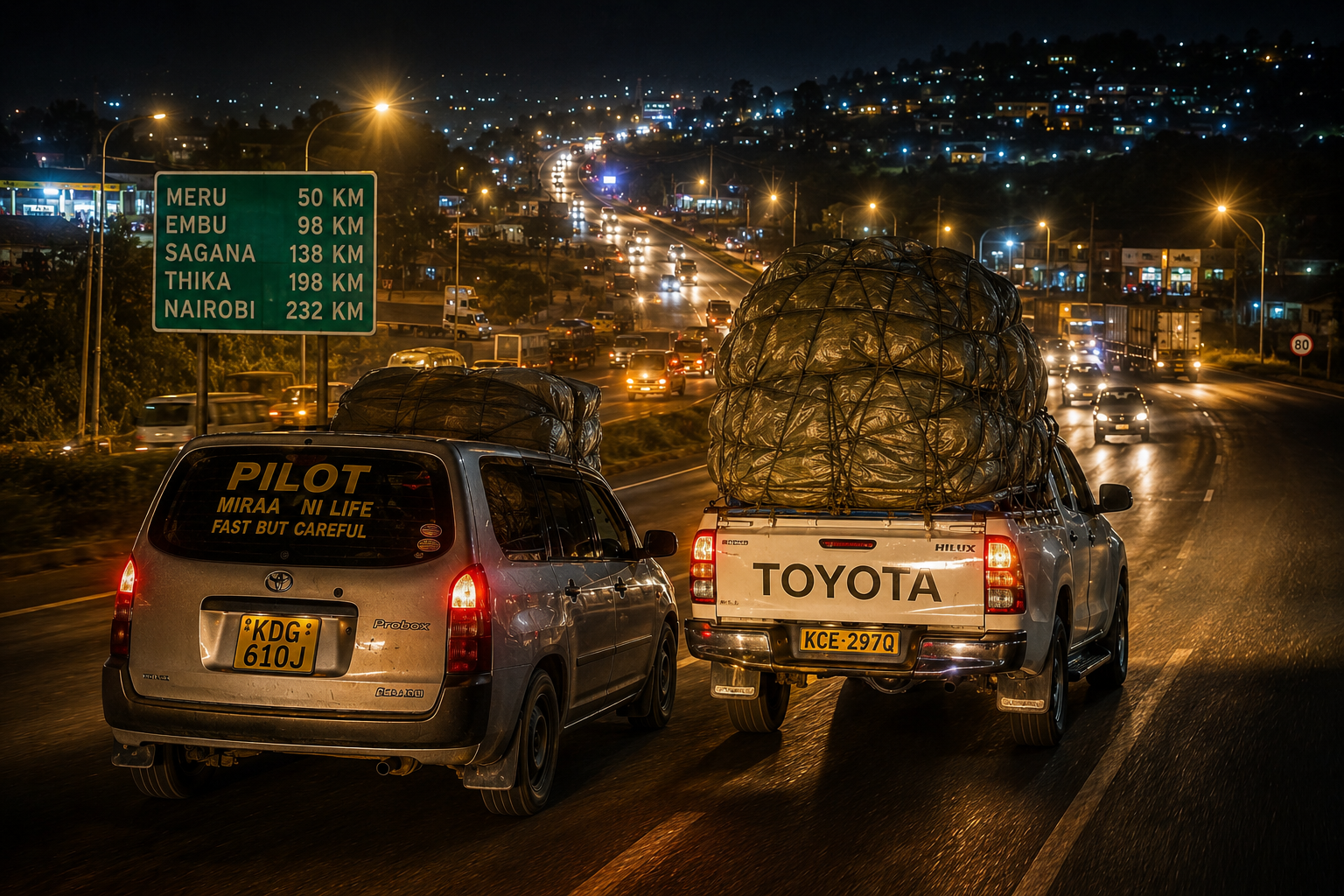
The Probox eats the road.
Kilometers disappear in silence except for the steady hum of the engine and the whisper of tires gripping asphalt. Musa doesn't notice speed anymore. Speed stopped feeling fast years ago.
What he notices is rhythm.
Every road has a rhythm.
Every highway has a mood.
Tonight, the road feels cooperative.
That is rare.
The Clock in the Back Seat
Most cargo gets slower with time.
Miraa gets poorer.
Every minute after harvest, the leaves begin a quiet surrender. Moisture fades. Freshness slips away. The bright green dulls toward fatigue. The price falls with it.
By sunrise, the difference between "fresh" and "late" can be the difference between profit and loss for dozens of traders waiting in Nairobi markets.
Musa isn't just driving leaves.
He is driving a countdown.
Behind him sits nearly one and a half tonnes of miraa bundles compressed into every available inch of space — seats folded, floor stacked, roof strapped, suspension groaning slightly under the weight.
The car sits lower than it should.
Pilots call it "sitting serious."
How the Pilots Were Born
Before the highways improved… before smartphones… before WhatsApp groups and traffic alerts…
There were just drivers.
Then the demand grew.
Miraa spread beyond Meru. Nairobi became a nightly destination. Then Mombasa. Then across borders. Somalia. Tanzania. Even flights overseas.
Suddenly speed wasn't a luxury.
It was survival.
The fastest drivers earned more runs. The most reliable drivers built trust. The most fearless drivers became legends.
And somewhere along the way, someone started calling them pilots.
Because what they do stopped feeling like driving.
And started feeling like flying low.
The Invisible Brotherhood
Musa's phone lights up again.
He glances at the screen mounted beside the steering wheel.
A voice note arrives from another pilot ahead.
"Clear road past Sagana. Truck accident near Kenol, left lane blocked."
Information is currency on the night run.
No formal organization.
No office.
No uniforms.
Yet every night, dozens of drivers coordinate across hundreds of kilometers like a synchronized organism.
One driver flashes headlights = roadblock ahead.
Two quick calls = accident.
Missed call at a specific hour = safe passage.
No one teaches this system.
You survive long enough to learn it.
The Economics of Urgency
Each trip feeds an entire chain:
Farmers harvesting at dusk.
Loaders working by flashlight.
Drivers racing the night.
Middlemen waiting before dawn.
Traders in city markets at sunrise.
Customers by mid-morning.
A single Probox arrival ripples through hundreds of livelihoods.
And if a shipment arrives late?
The ripple reverses.
Loss travels faster than profit.
Midnight at 130 km/h
The road past Kenol opens wide.
This is the stretch pilots talk about like athletes talk about a stadium.
Long. Smooth. Predictable.
Musa accelerates.
The engine deepens its voice. The steering wheel vibrates softly with the road's texture. The headlights stretch forward like twin tunnels carved into darkness.
In this moment, the world narrows to three things:
Road.
Speed.
Time.
Nothing else exists.
Not bills. Not politics. Not tomorrow's worries.
Only the vanishing point ahead.
The Weight of Responsibility
At home, Musa's children think he drives "night shifts."
They don't know the details.
They only know mornings.
Morning pancakes when he is home early.
Morning silence when he arrives late and sleeps through the day.
Morning stories when he brings fruit from roadside markets.
His wife doesn't ask too many questions either.
She only asks one:
"Umefika?" — Have you arrived?
It is the only question that matters.
Trucks, Buses, and Ghosts
Past midnight, the highway changes personality again.
Long-distance buses begin their kingdom. Massive machines painted in bright colors roar through the darkness carrying sleeping passengers across the country.
Truck convoys crawl steadily, climbing hills like metal elephants.
Motorbikes flicker in and out of visibility, their single headlights dancing unpredictably.
Every driver here is chasing something:
Passengers.
Cargo.
Deadlines.
Dreams.
The night highway is Kenya's bloodstream.
And tonight, it is flowing fast.
The Near Miss
It happens in seconds.
A truck ahead swerves slightly to avoid a pothole. Musa sees it before it happens. Pilots develop a sixth sense for vehicle behavior — the subtle drift, the hesitation, the shift in headlights.
He eases off the accelerator.
A bus appears in the oncoming lane.
A narrow window opens between two moving giants.
Musa takes it.
Smooth. Precise. Calculated.
The Probox slips through the gap like water through fingers.
Then the road opens again.
Heart rate steady.
No adrenaline spike. No celebration.
Just another calculation completed.
Why They Keep Doing It
The pay is good on successful nights.
Better than most day jobs.
But money alone doesn't explain the pilots.
There is something else.
Something addictive about night roads.
About beating time.
About belonging to a hidden fraternity most people never notice.
By day, they are ordinary drivers.
By night, they are part of a moving legend.
Thika Lights on the Horizon
2:43 AM.
The first glow of Nairobi's outer lights begins painting the sky faint orange.
For pilots, this sight feels like a finish line ribbon stretching across the horizon.
Traffic thickens. Matatus appear. Early commuters begin stirring. The city yawns awake.
The hardest part is over.
But the mission is not finished.
Not until the miraa is in the hands of traders.
Not until the engine turns off.
Not until the message is sent:
"Delivered."
Dawn Delivery
By 4:30 AM the Probox rolls into Eastleigh.
The streets are already alive.
Traders move with urgency. Buyers inspect bundles with experienced fingers. Negotiations start instantly, voices overlapping like market music.
Musa opens the rear door.
The scent of fresh miraa spills into the morning air.
Men appear immediately, unloading with the same speed used hours earlier in Meru.
The cargo disappears within minutes.
Hours of driving erased in a blur of movement.
The clock stops.
The race ends.
The quiet after the storm.
At 5:12 AM, Musa finally switches off the engine.
Silence floods the cabin.
He leans back, eyes closing for a moment.
Nairobi morning traffic begins building around him.
For the rest of the city, the day is beginning.
For Musa, the night is finally over.
He sends one message:
"Umefika."
Then starts the long drive home, chasing sleep instead of time.
Tonight, the road will wait again.
And tomorrow night, it will call.
