
The beaches are real. The history is extraordinary. The costs are higher than you expect. Here's everything nobody tells you before you go.
Key Facts
Location: Indian Ocean, 35km off Tanzania's coast
Best Time to Visit June–October (dry season) or December–February
Currency Tanzanian Shilling (TZS) — USD widely accepted Budget Per Day $40–90 (budget) · $120–250 (mid-range) · $300–600+ (luxury)
Visa Available on arrival for most nationalities — $50 USD
Language Swahili (Kiswahili) — English widely spoken in tourist areas
Getting There Fly into Abeid Amani Karume International Airport (ZNZ)
UNESCO StatusStone Town — World Heritage Site since 2000
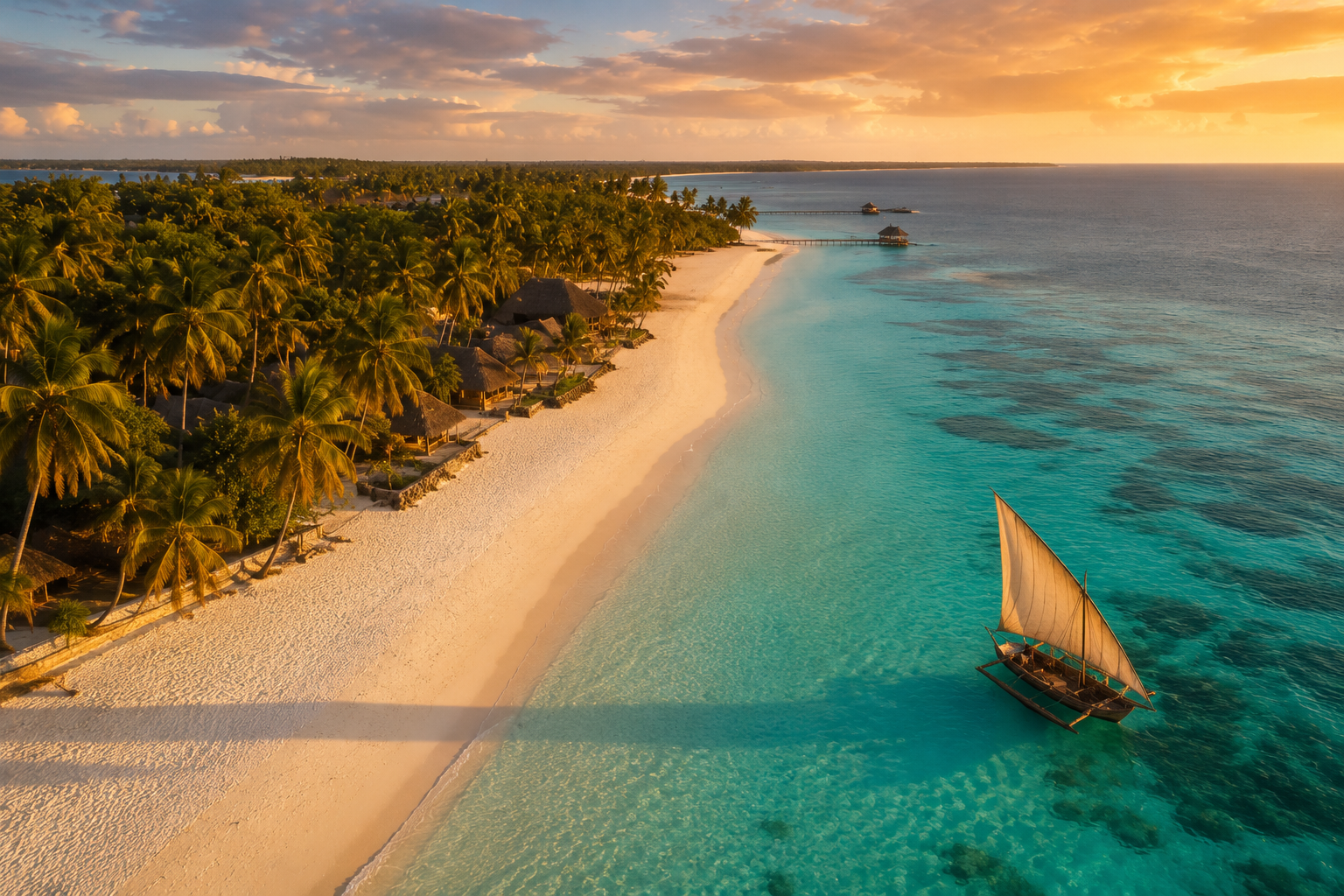
There is a moment that happens to almost every first-time visitor to Zanzibar. You've just landed. The heat wraps around you like a warm cloth the moment you step off the plane. You find your transfer, load your bags, and begin the drive from the airport. And then — maybe twenty minutes in, maybe thirty — the road opens up and you see it for the first time. The Indian Ocean. Impossibly blue. Flat as glass. Fringed by coconut palms so perfectly placed they look like someone arranged them deliberately. A dhow — one of the traditional wooden sailing boats that have crossed these waters for a thousand years — moving slowly across the horizon. You understand immediately why people come here and never quite leave. But Zanzibar is not a simple destination. It is layered — historically complex, culturally rich, and more expensive than most people budget for. It rewards the traveler who comes prepared and punishes the one who doesn't. This is the guide I wish existed before I first planned a trip here. The honest one. Not the brochure version.
What Zanzibar Actually Is Most people think of Zanzibar as a beach destination. It is. But that description is like saying the Louvre is a building — technically accurate and entirely insufficient. Zanzibar — officially the Zanzibar Archipelago, though most people mean the main island of Unguja when they say the name — is a semi-autonomous region of Tanzania sitting in the Indian Ocean about 35 kilometres off the East African coast. It is a place where eight centuries of trade between Africa, Arabia, Persia, India, and Europe left a cultural fingerprint unlike anywhere else on the continent.
The Arab traders who settled here from the 8th century onward. The Portuguese who arrived in the 16th century and built their fort. The Omani Sultanate that made Zanzibar its capital in the 19th century, turning it into the most important trading hub in the Indian Ocean — trading in cloves, ivory, and enslaved people. The British colonial period that followed. And underneath all of it, the Swahili civilization that absorbed every influence and remained distinctly itself.
All of this — centuries of arrival, departure, trade, and tragedy — is written into the stones of Stone Town, the smells of the spice markets, the architecture of the doorways, and the language of the people. Zanzibar is a beach destination. It is also one of the most historically layered places in East Africa. Come for the beaches. Stay for everything else.
When to Go — And When to Stay Away
The dry seasons are your friends: June to October is the primary dry season — warm days around 25–28°C, low humidity, minimal rain, and the clearest underwater visibility of the year. This is peak season, which means higher prices and more tourists. Book accommodation and flights at least 3–4 months in advance. December to February is the short dry season — slightly hotter, still excellent weather, and generally less crowded than the June–October peak.
The seasons to avoid: March to May is the long rainy season — heavy, sustained rains that can last for days. Roads flood. Some smaller guesthouses and camps close. Prices drop by 20–30% if you're budget-conscious and don't mind unpredictable weather. November brings the short rains — lighter than March–May but still unpredictable. A gamble that sometimes pays off and sometimes doesn't. The honest truth about timing: June to August is when the Maasai Mara Great Migration is also at its peak — which means if you're combining a Kenya safari with Zanzibar beaches, the timing aligns perfectly. Many travelers do exactly this: fly into Nairobi, head to the Mara for the crossing, then fly south to Zanzibar for a week of recovery. It's one of East Africa's great travel combinations. Planning a Kenya safari first? Read our complete Maasai Mara Guide here →
Getting There — Flights and What They Actually Cost
International flights into Zanzibar (ZNZ) are limited. Most travelers fly into either Dar es Salaam (DAR) on the Tanzanian mainland or Nairobi (NBO) in Kenya, then connect onward. From Nairobi, the flight to Zanzibar takes approximately 1.5–2 hours. Expect to pay $150–350 return depending on the airline and season. Kenya Airways and Precision Air both operate this route regularly. From Dar es Salaam, the short flight to Zanzibar takes 20 minutes and costs $200–400 round trip. You can also take the ferry — a 2-hour crossing that costs approximately $35–55 — if you're already on the mainland and want a slower, cheaper option. From Europe and North America, expect return flights in the range of $700–1,400 depending on origin, season, and how far in advance you book. Flying via Nairobi with Kenya Airways or via Addis Ababa with Ethiopian Airlines typically offers the best combination of price and schedule.
Search and compare flights to Zanzibar here →
One thing most guides don't mention:
Book your Nairobi–Zanzibar or Dar–Zanzibar connecting flight carefully. Missed connections on this route are common because Zanzibar flights operate on tight schedules and don't always wait. Give yourself at minimum a 3-hour connection window at Nairobi's JKIA — it's a large airport and immigration can be slow.
Where to Stay — The Four Zones of Zanzibar
Zanzibar's accommodation divides cleanly into four geographic areas, each with a completely different character. Where you stay will define your experience. Stone Town — Culture and History
Stone Town is Zanzibar's historic heart — a UNESCO World Heritage Site and one of the most atmospheric urban environments in East Africa. Narrow cobbled alleys twist between buildings that haven't changed much since the Omani Sultanate. Intricately carved wooden doors — Arab-style with brass spikes, Indian-style with geometric patterns — open onto hidden courtyards. The air smells of cloves, salt, and frying fish.
Stay here for your first 2–3 nights. Walk the alleys at dawn before the heat arrives. Eat at the Forodhani Night Market on the waterfront. Visit the Palace Museum, the Old Fort, and the House of Wonders. Find the small unmarked doorway on Shangani Street that was once the home of Freddie Mercury — yes, that Freddie Mercury, who was born in Zanzibar in 1946 as Farrokh Bulsara.
Budget accommodation in Stone Town: $25–60 per night for locally-owned guesthouses Mid-range boutique hotels: $80–180 per night Luxury heritage hotels: $200–400+ per night
Search Stone Town hotels here →
Honest note: Stone Town does not have good beaches. The waterfront is atmospheric but not for swimming. If you want sand and sea, you need to be in one of the beach zones. Nungwi and Kendwa — The North Coast The northwest tip of the island is where you go for the classic Zanzibar postcard — long white beaches, turquoise water, and sunsets that make grown adults go quiet. Nungwi is the most developed of the northern beaches — lively, social, with a genuine fishing village at its heart surrounded by ever-expanding resort development. The beaches here have minimal tidal variation, which means you can swim all day without the beach disappearing at low tide (a real issue on the east coast).
Kendwa, just south of Nungwi, is slightly quieter and less developed. Better for couples and honeymooners. Known for its famous full moon parties if that's your scene. Accommodation: $40–200 per night for mid-range options. Luxury resorts start at $300+.
Search Nungwi and Kendwa hotels here →
Paje and Jambiani — The East Coast
The east coast is different energy entirely. Flatter, more open, with long shallow beaches and the consistent winds that have made Paje the kite surfing capital of the Indian Ocean. The honest thing about the east coast: the tides are dramatic. At low tide, the water retreats so far you can walk hundreds of metres across exposed reef and sand before reaching swimming depth. At high tide, the same beach is perfect. Check the tide tables before you plan your beach days.
Paje is bohemian and social — eco-lodges, kite surfing schools, beachside cafes. Good for younger travelers, adventure seekers, and anyone who wants to learn to kite surf. Jambiani, just south of Paje, is slower and more culturally immersed — a proper working fishing village where you're staying alongside local life rather than in a tourist bubble. Accommodation: $40–150 per night. More budget-friendly than the north coast.
Search Paje and Jambiani hotels here →
Matemwe and the Northeast — Luxury and Seclusion The northeast coast is where the luxury resorts concentrate for a reason — stunning beaches, calm water, and dramatic views across to Mnemba Atoll, one of the best dive sites in the Indian Ocean.
If budget is not the primary concern, the northeast is where Zanzibar truly rewards you. Boutique resorts with private pools, excellent diving and snorkelling, and the kind of quiet that makes a week feel like a month. Accommodation: $150–600+ per night.
What Things Actually Cost in 2026
Let me give you real numbers rather than ranges so wide they're useless. Daily budget breakdown — per person: Travel StyleDaily CostWhat You GetBudget$40–90Guesthouse, local restaurants, public transport, one activityMid-range$120–250Boutique hotel, mix of local and tourist dining, organised excursionsLuxury$300–600+Resort, fine dining, private guides, premium experiences Specific costs to know:
Spice farm tour — $20–30 with a local guide, $180 through a hotel. Book direct, always. Stone Town walking tour — $15–40 depending on guide Snorkelling trip to Mnemba Atoll — $50–80 per person Dolphin tour at Kizimkazi — $30–50 per person Prison Island (tortoise sanctuary) — $10 entry + $10–20 boat transfer Local meal (restaurant) — $5–15 Hotel restaurant meal — $20–50 Zanzibar pizza at Forodhani Night Market — $2–4 and worth every cent Dala dala (local minibus) — $1–3 per ride across the island Taxi Stone Town to Nungwi — $25–40, always negotiate before you get in Scooter rental — $15–25 per day
The hidden costs most guides skip: Zanzibar Conservation Fee — $10 per person, payable at the airport on arrival. Not optional. Yellow fever certificate — If you're arriving from Kenya or most other African countries, you need proof of yellow fever vaccination. Carry your yellow card. Without it, complications at the border are real. Hotel booking markup on tours — Hotels mark up excursions by 20–40%. Always book activities directly with local operators or through your guesthouse at local rates. A week in Zanzibar — realistic total costs (excluding international flights):
Budget: $700–1,200 per person Mid-range: $1,200–1,800 per person Luxury: $2,500–5,000+ per person
What to Do — Beyond the Beach The beach is obvious. Here's what you might miss. The Spice Farm Zanzibar was once the world's largest clove producer — which is why it's still called the Spice Island. A spice farm tour is not a tourist gimmick. It is genuinely extraordinary to stand in a forest where the air smells of nutmeg and vanilla, where your guide breaks a cardamom pod open for you to taste, where you learn that the lipstick-red covering around a nutmeg seed is what we call mace. Book directly with a local guide — not through your hotel. Pay $20–30, not $180. The experience is identical. Stone Town After Dark The Forodhani Gardens night market on Stone Town's waterfront has been running for decades. Local vendors set up grills after sunset and cook fresh seafood — lobster, prawns, octopus — alongside Zanzibar's famous local specialty: Zanzibar pizza, which is not pizza at all but a thin fried dough pocket stuffed with meat, egg, vegetables, and Nutella if you want it. Eat here on your first night. Eat here on your last night. Eat here as many nights as you can. Diving and Snorkelling The waters around Zanzibar contain some of the most biodiverse marine ecosystems in the Indian Ocean. Mnemba Atoll — a small uninhabited island off the northeast coast — is consistently rated among the top dive sites in East Africa. Whale sharks visit the waters around Unguja seasonally. Green turtles nest on the northern beaches. Even if you don't dive, a snorkelling trip to Mnemba is worth every cent. Prison Island Twenty minutes by boat from Stone Town, Prison Island was built as a holding facility for enslaved people before they could be transported — though it was never fully used for this purpose. Today it houses a sanctuary for giant Aldabra tortoises, some of which are over 100 years old. The combination of history and wildlife in one small, beautiful place is quintessentially Zanzibar.
Jozani Forest
The only national park on the island, Jozani is home to the rare Red Colobus monkey — found nowhere else in the world. The forest walk is quiet, shaded, and entirely different from the beach energy. A good half-day trip from anywhere on the island.
The Honest Things Nobody Tells You
The tides will surprise you. On the east coast especially, low tide dramatically changes the beach. Research tide times for your specific dates and location before you arrive. Stone Town is loud at night. Beautiful during the day, chaotic at night. If you're a light sleeper, pay for a hotel with air conditioning and proper insulation. The narrow alleys amplify sound in every direction.
Negotiate everything outside of hotels. Taxis, tour operators, market vendors — prices are almost always flexible. Not aggressively, not rudely. Just calmly. "What's your best price?" is a culturally appropriate question.
Ramadan changes everything. If you visit during Ramadan, many local restaurants will be closed during daylight hours. Respect the fast in public spaces — don't eat or drink visibly on the streets during the day. The evenings during Ramadan are actually spectacular — the island comes alive after sunset.
The tap water is not safe to drink. Drink bottled or filtered water only. This is non-negotiable.
Zanzibar is a Muslim-majority island. Dress modestly away from beach areas — cover shoulders and knees when walking in Stone Town or visiting villages. This is basic respect and the locals notice and appreciate it.
The internet is unreliable. Don't plan on working remotely from Zanzibar without a local SIM card. Buy a Vodacom or Airtel Tanzania SIM at the airport — data is cheap and the coverage is better than most hotels' WiFi.
Getting Around
Within Stone Town: Walk. The alleys are too narrow for vehicles and half the beauty is getting lost in them. Just keep the waterfront as your compass. Stone Town to beaches: Shared minibuses (dala dalas) go everywhere for $1–3 but are slow and packed. Private taxis cost $25–40 to the north coast. Renting a scooter for $15–25 per day gives you complete freedom and is the best way to explore if you're comfortable riding. Between beach areas: Hire a taxi for the day ($40–60) or rent a scooter. There's no reliable public transport between the east and north coasts.
A 7-Day Itinerary That Actually Works Days 1–2: Stone Town Arrive, settle in, explore the alleys, eat at Forodhani. Take a guided walking tour on day 2. Visit the Palace Museum and the slave memorial. Day 3: Spice Farm + Prison Island Morning spice tour (book direct), afternoon boat trip to Prison Island. Back to Stone Town for sunset from one of the rooftop bars. Days 4–5: North Coast (Nungwi or Kendwa) Transfer north. Two full beach days. Snorkelling trip to Mnemba Atoll on day 5. Day 6: East Coast (Paje) Drive across the island. Different energy entirely. Try kite surfing if that's your thing. Sundowner at a beachside café. Day 7: Jozani Forest + Departure Morning in Jozani Forest to see the Red Colobus monkeys. Afternoon transfer to the airport.
Is Zanzibar Worth It?
Here's the question I get asked most often about Zanzibar. Yes. Unambiguously yes. Not because it's cheap — it isn't. Not because it's undiscovered — it isn't that either. But because there are very few places on earth where you can stand in a 14th-century Arab fort in the morning, eat the best seafood of your life at a night market, watch a dhow sail across an ocean that has been sailed for a thousand years, and still be on a beach with water that colour by the afternoon.
Zanzibar is not a secret. It is just genuinely, stubbornly extraordinary. Go once and you'll understand why people keep going back.
Zanzibar pairs perfectly with a Kenyan safari. Read our complete guides:
