
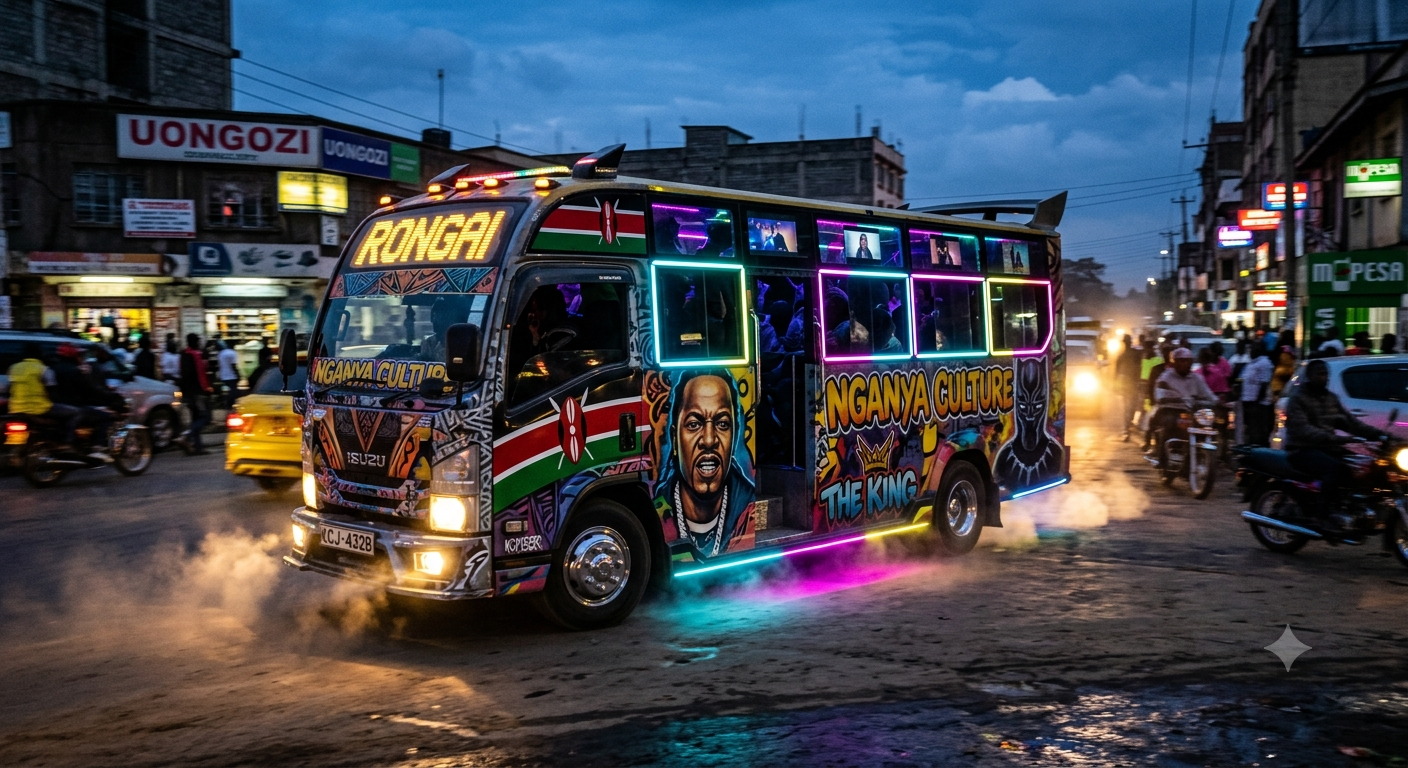
A bus pulls up. The bass hits before the doors open. Rihanna's face stares out from the side panel next to a Kenyan flag and a proverb in Sheng. This is how you get to work in Nairobi.
You know a nganya is coming before you see it.
The bass arrives first — a low frequency that you feel in your chest before your ears fully register it. Then the vehicle itself rounds the corner, and whatever you were doing stops mattering for a second, because there is a fourteen-seat minibus coming toward you painted with the face of a Kenyan music icon on one side, a scene from a Marvel film on the other, LED strips pulsing along the window line in time with whatever is playing inside.
This is a matatu. In Nairobi, they call the loudest, most customised ones nganya. And they are, without exaggeration, one of the most extraordinary examples of grassroots urban art anywhere on the African continent.
What a Matatu Actually Is
Strip away the culture for a moment and a matatu is simple: a privately owned minibus, seating 14 to 33 passengers, operating on a fixed route, charging a fare that adjusts with time of day, weather, and how badly you need to get somewhere.
Matatus carry the overwhelming majority of Nairobi's daily commuters. There is no comprehensive public rail system to compete with them. No unified city bus network that reaches every estate. If you live in Nairobi and don't own a car, you know matatus intimately — their routes, their rhythms, which ones to avoid at rush hour, which conductor on your regular route calls you by name.
The base vehicle is often an Isuzu NQR — a Japanese truck chassis reworked into a minibus. Owners favour it for practical reasons: affordable to acquire, a 33-seater capacity that fits PSV regulations while maximising passenger turnover, and an engine known across Kenya for reliability. Parts are available everywhere. Mechanics in Nairobi and in small upcountry towns both know how to fix them.
That's the functional layer. Then there's everything built on top of it.
How a Fifty-Year-Old Transport System Became a Moving Art Gallery
The transformation didn't happen by design. It happened because of a wall problem.
Nairobi's street artists in the early 2000s faced a specific obstacle: there were almost no legal walls to paint on. Graffiti was viewed with suspicion — visual noise to be scrubbed away, not a craft worth commissioning. If you were a young artist trying to build a name in Nairobi, the city itself was closed to you.
So the canvas moved. If the walls were off-limits, the answer wasn't on the walls at all — it was in motion, woven into the rhythm of the city's daily transport. Matatu owners needed to pull in passengers on competitive routes, and a plain white minibus doesn't stand out in traffic. A matatu covered in bold portraiture, sharp lettering, and unmistakable colour does.
The artists needed a canvas. The owners needed customers. The arrangement made itself.
What followed was two decades of escalating creative ambition. Faces of Rihanna and Bob Marley next to Kenyan musicians and footballers. Matrix-inspired liveries. Entire matatus themed around a single film, a single artist, a single idea — executed with a level of technical skill that would not look out of place in a gallery, except the gallery is doing 60 kilometres an hour down Jogoo Road at 7am.
A community space called WaPi — Words and Pictures, backed early on by the British Council and later housed at the Sarakasi Dome in Ngara — became the meeting point where Nairobi's first generation of graffiti artists found each other, traded technique, and built the credibility that eventually let their work move from suspicion to celebration.
What It Feels Like From Inside
Step onto a serious nganya and the transport function almost disappears.
The interior is built to feel like a nightclub compressed into a fourteen-seater frame. Screens mounted where headrests would normally be. Speaker systems powerful enough that you feel the kick drum in your sternum before the melody registers. LED strips running the length of the ceiling, shifting colour with the music. Upholstery reworked to match the exterior theme — if the outside is Baba Yaga, the inside commits to that world completely.
The conductor — locally, the makanga — is part of the performance. On the loudest routes, makangas don't just collect fares. They hype the vehicle, call out to people on the street to board, keep the energy of the ride matched to whatever is playing. Riding a serious nganya during rush hour is closer to a shared communal event than a commute. Strangers nod along to the same track. Someone's cousin knows the artist who painted the side panel. A stranger asks the makanga to turn it up, and he does.
Praise Mwangi, a young Nairobi commuter, described it simply: when you ride it, you feel the vibe with other youths, and you get to interact more with them. That's the part outsiders miss most. It isn't only visual spectacle. It's a shared social space that happens to also get you to work.
Rongai and the Geography of Style
Certain neighbourhoods have built specific reputations within the culture.
Rongai, on Nairobi's southern edge, has become known as the home of the city's most stylish nganyas — a competitive hub where owners push customisation standards higher because the local audience expects it and rewards it with ridership. Embakasi, Umoja, and Pipeline carry similar reputations on the eastern side of the city, each route developing something close to a house style, recognisable to regular riders even before they see the name painted on the side.
Some individual nganyas have become genuine local celebrities — vehicles like Baba Yaga, Moneyfest, Opposite, and Mood, each with dedicated followings that track their appearances, their redesigns, their launch events. Some nganya social media pages have built followings in the hundreds of thousands. When a new design launches, it can draw a crowd, live performances, and enough online attention to trend for days.
This is Kenyan youth culture building its own media ecosystem, entirely outside of traditional entertainment industry structures, using public transport vehicles as the platform.
The Livelihood Underneath the Spectacle
It's easy to see a nganya purely as visual entertainment. Underneath the graffiti and the sound systems sits a functioning creative economy that employs a genuine cross-section of Nairobi's working population.
Graphic designers plan the concept. Painters and airbrush specialists execute it — a single high-end matatu redesign can take months and involve an entire team. Electricians and sound technicians install and maintain the LED and audio systems. Fabricators handle structural modifications. DJs curate the playlists that define a route's identity. Mechanics keep the underlying vehicle running. Drivers and conductors operate it daily.
Cliff Khalifa, an artist who has built a career within the industry, put it plainly: success in this industry requires both skill and continuous learning. This isn't a hobby scene. It's a livelihood, and for the artists who reach the top of it, a genuine career.
For a graffiti artist named Babel Gody, who has worked on some of Nairobi's most recognised matatus, each vehicle carries a specific intention: each matatu tells a story — it reflects the owner's dreams and the community's vibe. That's not marketing language. Watch enough matatus pass and you start to see it — the specific hometown pride painted on one, the tribute to a fallen local hero on another, the shared joke between owner and artist rendered in six-foot lettering across a door panel.
The Fight Happening Right Now
As of early 2026, matatu culture is in the middle of a genuine legal battle — one that reveals exactly how much this art form means to the people who live inside it.
In January 2026, the National Transport and Safety Authority issued a notice effectively restricting decorative graffiti, tinted windows, and other creative modifications on public service vehicles, citing road safety concerns. Artists, owners, and fans responded by taking the matter to court, arguing that nganya culture qualifies as constitutionally protected cultural expression — shared beliefs, values, social norms, and artistic expressions that provide identity, creativity, and livelihoods to thousands of people.
The petitioners pushed back hard on the safety justification, calling it unsupported by any disclosed evidence. Lang'ata MP Phelix Odiwuor — known publicly as Jalang'o — pledged to personally finance a legal appeal, describing the culture in terms that go well beyond entertainment: people travel from all over just to experience matatu culture — the art, the music, the energy. It's more than transport. It's part of who we are.
Nairobi Governor Johnson Sakaja has previously defended the culture in similar terms, describing matatu graffiti and music as part of the city's identity and pointing out that commuters can simply choose a quieter vehicle if the nganya experience isn't for them.
The case remains unresolved. But its existence tells you something important: this is not a niche subculture that a handful of enthusiasts will mourn if it disappears. It is contested, defended, and litigated because it has become genuinely central to how a generation of Nairobi residents understands its own identity.
Riding One Yourself — A Practical Note
If you're visiting Nairobi and want to experience matatu culture rather than just observe it from the pavement, here's what you should know.
It's the most affordable way to see the city. Fares typically run 30–100 KES depending on route and distance — a fraction of ride-hailing costs, and it puts you directly inside the experience rather than watching it from a car window.
Go with the flow. Matatus are loud, fast-paced, and unapologetically themselves. Don't argue with the crew about music volume, driving style, or route. If something feels genuinely wrong, simply exit at the next stop.
Keep valuables secure, as you would on any busy public transport system anywhere in the world. Pickpocketing can happen in crowded routes, particularly during rush hour.
A small courtesy goes a long way. A greeting to fellow passengers, a thank you to the makanga as you disembark — small gestures that fit naturally into Nairobi's communal transport culture.
Central Business District routes give you the best introduction — high traffic, competitive designs, and the shortest wait times if you want to see several nganyas pass before choosing one.
Why This Matters Beyond Nairobi
There is something worth sitting with in the fact that Nairobi's most original contemporary art movement didn't emerge from a gallery, a grant programme, or an institution. It emerged from a transport problem and a lack of legal walls, and it built itself into a self-sustaining creative economy entirely on its own terms.
Matatu graffiti has become, without official sanction or institutional funding, one of the most visible and widely consumed art forms in East Africa — seen by more people daily than any gallery exhibition, generating more livelihoods than most formal arts programmes, and now significant enough to warrant a constitutional court challenge in its own defence.
It represents something Nairobi's youth built for themselves, out of limitation rather than opportunity, and turned into a genuine cultural export that photographers, journalists, and travellers now specifically seek out.
Next time a nganya passes you on Jogoo Road or Thika Road, bass shaking the windows, LED lights cutting through the exhaust and dust — you're not just watching public transport. You're watching one of the most honest art movements on the continent, built by people who were told there was no wall for them, and decided the whole city would be their wall instead.
Matatu culture is one piece of Nairobi's wider creative identity. Explore more East Africa culture and history:
- How Amapiano Took Over East Africa's Streets & Clubs →
- The Night Run: Inside Kenya's Secret Miraa Pilots →
- Kenya Travel Guide 2026 →
Explore more East Africa stories at vumbiventures.com/blog