The Maasai Mara, Kenya. July. The river is waiting.
Nobody warns you about the silence before it happens.
You've seen the footage. Everyone has. The wildebeest stampeding into the Mara River, the crocodiles erupting from the water, the chaos of a million animals moving as one. You think you know what to expect. You've prepared yourself for spectacle.
What you haven't prepared for is the hour before.
You're in an open vehicle at the edge of the Mara River bank, the engine off, the guide speaking in a low voice as if raising it might change something. The light is the colour of old honey. On the opposite bank, a mass of wildebeest stretches back so far into the plain that you cannot see where it ends — a living, breathing, shifting carpet of bodies pressed against each other, hundreds of thousands of animals standing at the edge of a decision none of them wants to make first.
The river below is brown and quiet. Deceptively quiet.
Something enormous moves beneath the surface.
The Migration That Rewrites Everything You Know About Nature
The Wildebeest Migration is officially the largest overland wildlife movement on earth. Between 1.5 and 2 million wildebeest — along with roughly 200,000 zebra and 500,000 Thomson's gazelle — complete a circular journey of over 1,800 kilometres through Tanzania's Serengeti and Kenya's Maasai Mara every single year.
They follow the rain. More precisely, they follow the grass that follows the rain — an ancient, instinct-driven circuit that has been running without pause for longer than recorded human history. No leader directs the route. No map exists. Something older than thought moves them forward.
The river crossings — which happen between July and October as the herds push north into Kenya — are the moment the Migration becomes almost impossible to believe.
Wildebeest are not graceful animals. They are awkward, unpredictable, slightly absurd-looking creatures that seem designed by a committee. Long faces, mismatched bodies, a kind of perpetual bewilderment in their eyes. And yet watching two million of them move together, you begin to understand something about collective intelligence — about the way a species survives not through individual brilliance but through sheer, overwhelming, unbreakable togetherness.
The Crossing
It begins with one.
One wildebeest steps to the edge of the bank, looks down at the brown water, and retreats. The herd behind presses forward. The animal returns to the edge. Retreats again. This can go on for hours — the entire herd held in suspension by the hesitation of a single animal at the front.
Your guide has seen this hundreds of times. He doesn't move. He doesn't check his phone. He understands something that takes visitors longer to learn: this moment cannot be rushed. The Migration operates on its own time.
And then — without warning, without any visible trigger — they go.
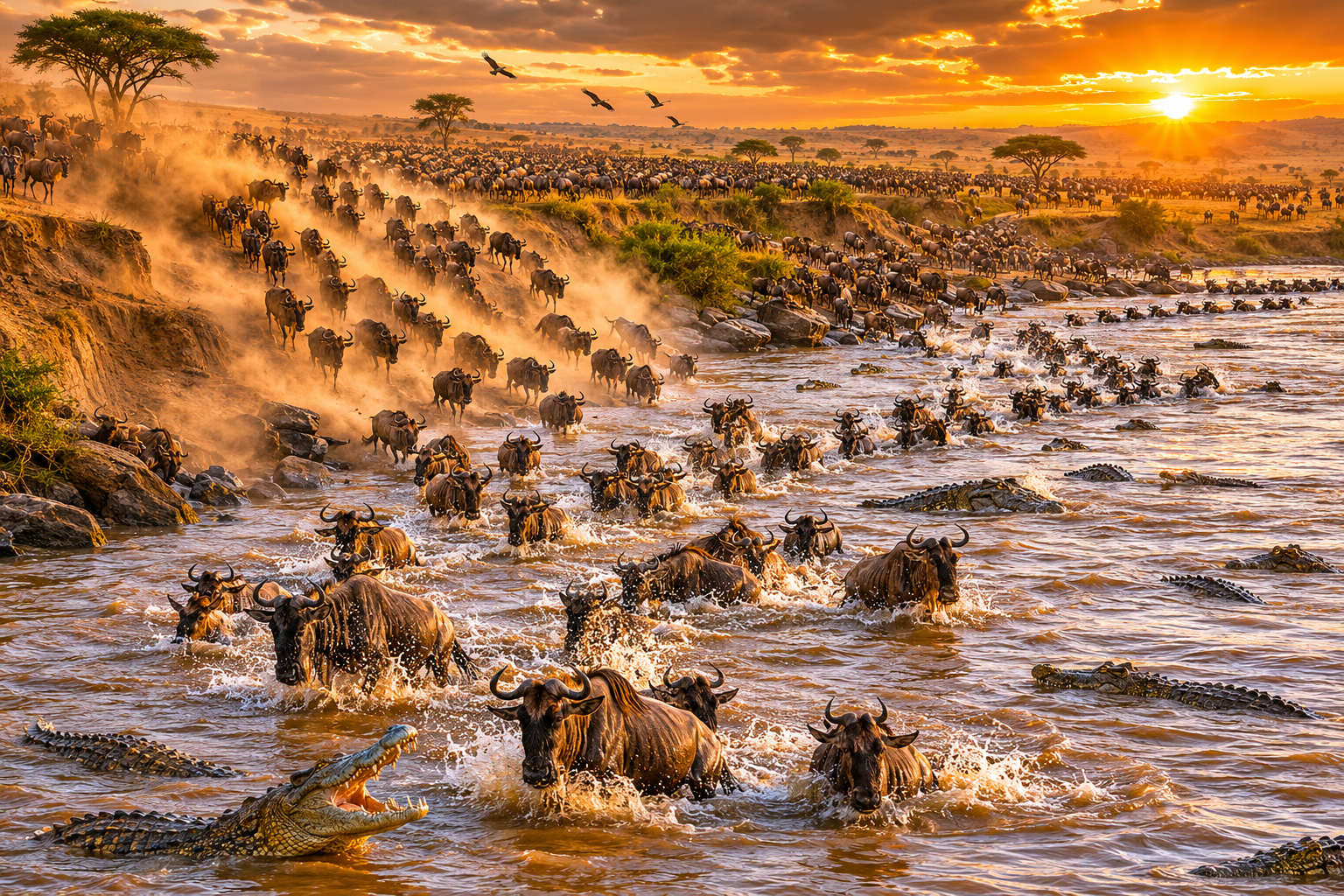
The first animal commits. Then the second. Then the bank dissolves into a waterfall of hooves and dust and sound — a sound that you feel in your chest before you hear it with your ears, a deep percussive thunder that rolls across the plain and doesn't stop.
They pour into the river like a liquid. The water turns white with movement. Some animals swim cleanly and emerge on the far bank within minutes, shaking themselves dry and immediately beginning to graze as if nothing happened. Others are swept downstream, fighting the current, legs churning. The crocodiles — which have been motionless in the water for so long they resembled logs — accelerate with a terrifying, ancient efficiency.
It is brutal. It is magnificent. It is the most honest thing you have ever witnessed.
Nobody in your vehicle says a word.
After the Crossing
What stays with you isn't the chaos. It's the aftermath.
The wildebeest that make it across the river begin grazing immediately — heads down, moving forward, as if the crossing was simply something that needed to happen and is now done. There is no celebration. No recovery period. The herd moves on because the herd always moves on.
The ones that didn't make it lie on the riverbank, already still. The crocodiles have returned to their patient stillness. In an hour, the river will look almost undisturbed.
Your guide drives you back through the golden afternoon light, past zebras drinking at a waterhole, past a pair of cheetahs watching the plains from a termite mound, past a sky that turns the colour of fire as the sun drops toward the Tanzanian border.
He asks if you're hungry.
You realise you forgot to eat.
The Practical Truth About Witnessing the Migration
The Great Migration crossing season in the Maasai Mara runs July through October, with August and September typically offering the highest concentration of river crossings. But the Migration is wild — it follows rain, not calendars — and no guide can guarantee a crossing on any given day.
What experienced visitors know:
The crossing is never the same twice. Some days hundreds of thousands of animals pour across in a single terrifying rush. Other days the herd stands at the bank for hours and then, inexplicably, turns around and walks away. The uncertainty is part of it.
Early mornings are when the crossings most often happen — before the heat of the day, when the light is extraordinary and the plains feel like they belong entirely to the animals.
Go with a guide who understands patience. The best wildlife moments in the Mara are never rushed toward — they are waited for.
Where to stay:
The Mara ecosystem has camps ranging from permanent lodges to luxury mobile tented camps that move with the herds. Staying inside or on the immediate edge of the conservancies — rather than the main reserve — gives you longer game drive hours and fewer vehicles at sightings.
The honest cost:
Witnessing the Great Migration properly is not cheap. Budget safaris exist and can get you there, but for the river crossings specifically, you want a knowledgeable guide with a good vehicle and the flexibility to wait. That means mid-range at minimum.
Search and compare Maasai Mara safari packages and lodges here →
Why the Mara Changes You
Travel writers have been trying to explain what happens to people in the Maasai Mara for decades. The plains. The scale. The quality of light in the late afternoon. The feeling of being somewhere that operates entirely outside human time.
The Migration strips something away from you that you didn't know you were carrying — the idea that the world exists primarily for and around human beings. Watching 1.5 million wildebeest move through ancient instinct, watched over by Maasai who have lived alongside these animals for centuries, you become — briefly, completely — a visitor in someone else's world.
That feeling doesn't leave you when you go home.
It's why people who've been to the Mara spend the rest of their lives trying to explain it to people who haven't.
And why the people who haven't keep ending up there eventually.
Planning a trip to the Maasai Mara? Read our complete guide: The Ultimate Maasai Mara Travel Guide 2026 — Planning, Costs, Best Time & Insider Tips
Explore more East Africa travel stories and destination guides at Vumbi Ventures blog
- Internal Link: blog/12 (Maasai Mara Travel Guide) Search and compare Maasai Mara safari packages


