
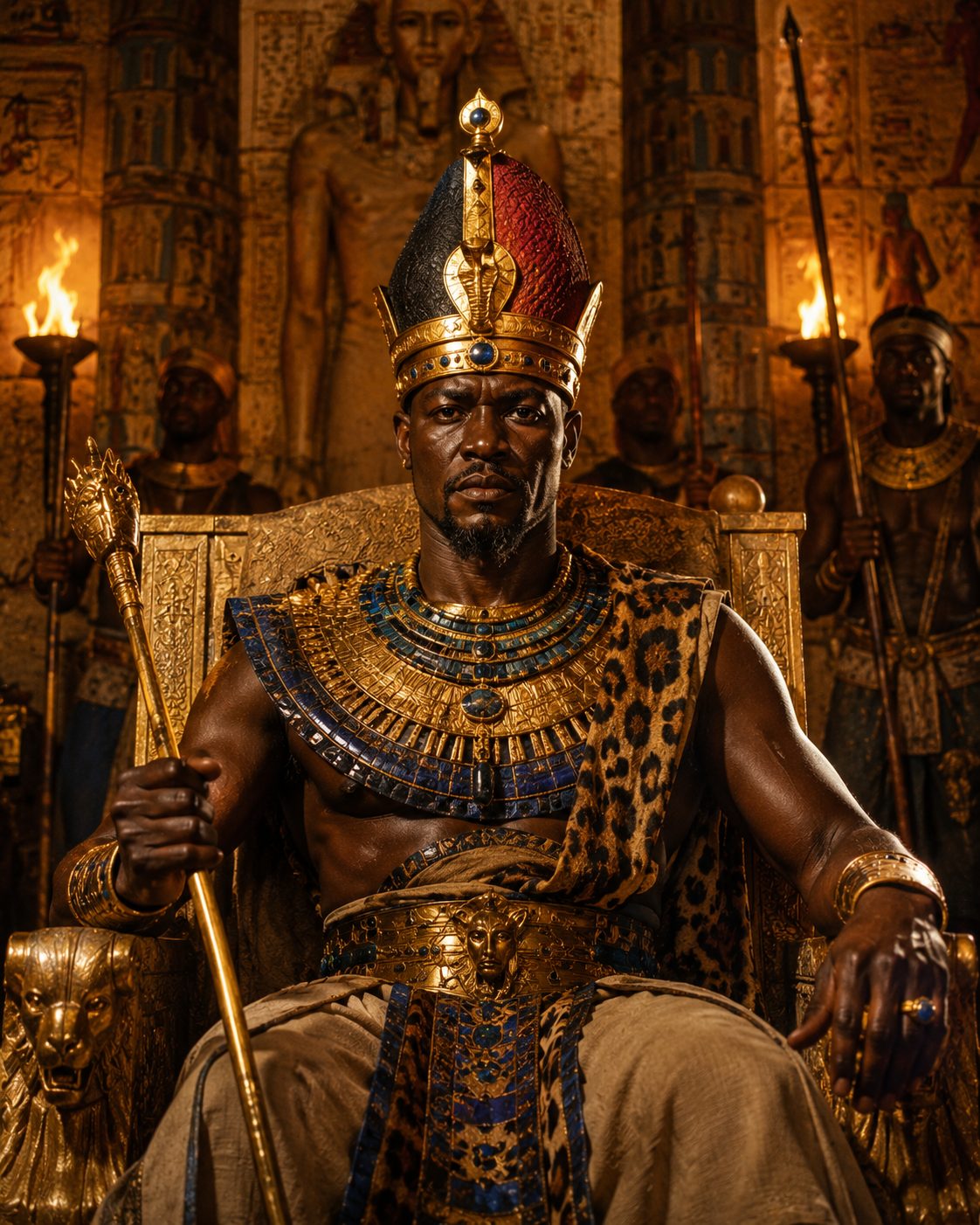
For sixty years, Black African kings sat on Egypt's throne, ruled from the Mediterranean to the heart of Africa, and built pyramids that still stand today. Here's the story they buried under centuries of miseducation.
There is a question that Egyptology spent two centuries avoiding. If ancient Egypt was one of the greatest civilizations in human history — and it was — then who were the people who conquered it? Not the Persians. Not the Greeks. Not the Romans. Those conquests came later.
The first people to conquer the full length of the Nile — from the heart of Africa all the way to the Mediterranean Sea — were Black African kings from the south. Kings who wore the double crown of Egypt, rebuilt its temples, and ruled its people for sixty years while maintaining their own distinct African identity.
They were the rulers of the Kingdom of Kush. And their story is one of the most extraordinary in all of human history.
The Land Before the Kingdom
To understand Kush, you first need to understand the geography that shaped it.
South of Egypt, where the Nile pushes through ancient rock and the desert gives way to fertile grassland, lies the region the ancient world called Nubia. Today it falls mostly within modern Sudan, with its northern reaches extending into southern Egypt.
The ancient Egyptians called it Ta-Seti — Land of the Bow — named for the extraordinary skill of Nubian archers who were among the most feared soldiers in the ancient world. Egyptian armies recruited them in enormous numbers. Nubian soldiers were not conscripts or slaves — they were valued specialists, professionals, warriors whose reputation preceded them across the ancient Mediterranean.
Nubia sat at the crossroads of everything. Trade routes connecting Egypt to the Red Sea passed through it. Gold and emerald mines in its hills produced wealth that flowed northward into Egypt for centuries. Agricultural land along the Nile fed its people. Iron ore deposits in its southern reaches gave it industrial capacity that Egypt lacked.
This was not a peripheral backwater waiting to be discovered. This was one of the most strategically positioned and naturally wealthy territories in the ancient world.
And the people who lived there knew exactly what they had.
The First Kingdom — Kerma
Before Kush there was Kerma — the first major urban civilization in sub-Saharan Africa, flourishing from approximately 2400 BCE to 1500 BCE.
Kerma was wealthy, sophisticated, and powerful enough to trouble Egypt repeatedly. At its height, Kerma controlled trade across the region and maintained a culture distinct from its northern neighbour — its own pottery styles, its own burial traditions, its own religious practices.
When the Hyksos — a foreign people from western Asia — invaded and occupied northern Egypt around 1650 BCE, the kings of Kerma formed a strategic alliance with them. The idea was to trap Egypt in a pincer movement — the Hyksos pushing from the north, Kerma pressing from the south. Had it succeeded, Egypt as a civilization might have ended.
It didn't succeed. The Egyptians eventually expelled the Hyksos and, freed from their northern threat, turned their full military attention southward. Under the Pharaoh Thutmose I, Egypt conquered Nubia as far as the Fourth Cataract of the Nile — a military campaign of enormous scale that brought Kerma to an end around 1500 BCE.
For the next four centuries, Egypt ruled Nubia. Nubian land was exploited for its gold, its people recruited into Egyptian armies, its culture slowly reshaped by Egyptian influence. New temples were built. Egyptian gods were worshipped alongside Nubian ones. Many Nubians learned Egyptian language and embraced Egyptian customs.
But absorption is not erasure. And empires do not last forever.
The Turning Point
In the eleventh century BCE, Egypt began to collapse.
The New Kingdom — the era of Ramesses II, of Tutankhamun, of Egypt's greatest imperial power — was disintegrating under the weight of succession crises, economic strain, and the pressure of external threats. The vast empire that had stretched from the Euphrates to the Fourth Cataract began to contract.
Egypt withdrew from Nubia.
And into the power vacuum that remained, the Nubian kings stepped forward.
By the ninth century BCE, a new Kushite dynasty had emerged in the region around Napata — a sacred city near the Fourth Cataract where the Egyptians had built the great temple of Amun at Jebel Barkal, a striking flat-topped mountain rising dramatically from the desert that both cultures considered a home of the gods.
The Kushite kings who rose to power here were not simply copying Egypt. They had absorbed Egyptian culture deeply — they worshipped Amun, they built pyramids, they used hieroglyphics, they called themselves Pharaohs. But they filtered all of it through a distinctly Nubian identity. Their pyramids were steeper and narrower than Egyptian ones. Their art preserved Nubian physical features and aesthetic traditions. Their queens held power that Egyptian royal women did not.
These were Africans who had learned from Egypt, been shaped by Egypt, and were now about to surpass it.
The Conquest — How Africa Took Egypt's Throne
By the eighth century BCE, Egypt had fragmented into competing city-states and rival dynasties. The great unified empire was gone. Local rulers controlled different regions. The priests of Amun at Thebes — Egypt's religious capital — held enormous influence but lacked military power.
Into this fracture, the Kushite king Kashta extended his influence northward, gaining control of Upper Egypt — the southern portion — around 760 BCE.
His son Piye finished what his father had started.
Around 730 BCE, Piye led his army northward in a military campaign of extraordinary ambition. City by city, dynasty by dynasty, he pushed through Egypt. Under Piye, the whole of Egypt to the shores of the Mediterranean was brought under the administration of Kush.
The victory stele Piye had erected to commemorate his conquest survives. It is one of the longest ancient Egyptian texts ever found — and one of the most revealing. Piye describes himself not as a foreign conqueror but as a righteous ruler restoring order to a land that had fallen into chaos. He was contemptuous of the Egyptian rulers he defeated — not because they were Egyptian but because they were, in his view, impious and corrupt.
He was a deeply religious man who saw himself as the true defender of Amun. When local rulers came to submit to him, he refused to meet some of them in person because they ate meat that was ritually impure. He was, by any measure, more Egyptian in his religious observance than the Egyptians he conquered.
The Kushite Pharaohs united the Nile valley from Khartoum to the Mediterranean. For the first time in centuries, the entire length of Africa's greatest river — from deep in the heart of the continent to the edge of the sea — was under a single ruler.
And that ruler was African.
The Black Pharaohs — Sixty Years on Egypt's Throne
Piye established the 25th Dynasty — the Kushite Dynasty — which ruled Egypt from approximately 747 to 656 BCE. Sometimes known as the "Black Pharaohs," Nubian kings ruled Egypt from roughly 760 BCE to 660 BCE.
The dynasty produced some of ancient Egypt's most remarkable rulers.
Shabaka — Piye's successor — consolidated Kushite control over Egypt and embarked on a programme of religious restoration, copying ancient Egyptian religious texts onto stone to preserve them from decay.
Taharqo — the greatest of the Black Pharaohs — ruled for twenty-six years and transformed both Egypt and Kush. Taharqa ruled over both Nubia and Egypt, restored Egyptian temples at Karnak, and built new temples and pyramids in Nubia. His sphinx — discovered by archaeologists and now in the British Museum — is one of the finest examples of ancient African sculpture in existence. His face, with its distinctly Nubian features, stares out from the granite with an authority that three thousand years has not diminished.
Under Taharqo, Egypt experienced a genuine cultural renaissance. Ancient texts were restored. Temple complexes were expanded. Trade networks were reactivated. The arts flourished. Contemporary accounts from across the Mediterranean describe Egypt under the Black Pharaohs as prosperous, stable, and powerful.
But the ancient world was changing around them.
The Assyrian Invasion — and the Strategic Retreat
In 671 BCE, the Assyrian Empire — armed with iron weapons that gave them a decisive military advantage over armies still equipped with bronze — invaded Egypt from the northeast.
In 671 BCE Egypt was invaded by the Assyrians, and by 654 BCE they had driven Kush back into Nubia.
Taharqo fought back twice — retaking Memphis on one occasion — but the Assyrian military technology was simply too advanced. Iron against bronze is not a contest. The Black Pharaohs were expelled from Egypt.
Here is where the story takes a turn that most histories get wrong.
The Kushite retreat from Egypt was not a defeat in any final sense. It was a strategic withdrawal to a kingdom that remained powerful, wealthy, and culturally vibrant for another thousand years.
Kush did not collapse when it lost Egypt. It evolved.
Meroe — The African Capital That Rome Couldn't Conquer
After the Assyrian expulsion, the Kushite capital gradually shifted southward from Napata to Meroe — a city in the fertile grasslands northeast of modern Khartoum that became one of the great urban centres of the ancient world.
Meroe became the centre of a flourishing economy and developed commercial links with the Mediterranean world. Art and architecture displayed Egyptian influence, but archaeology also points to a growth of local traditions.
Meroe was an iron-smelting powerhouse. The slag heaps that still surround the ancient city are so vast that archaeologists have called Meroe "the Birmingham of Africa" — a reference to the English industrial city that drove the 19th century industrial revolution. Kushite iron production supplied weapons and tools across sub-Saharan Africa for centuries.
The city was also a centre of religious innovation. A strong local element was apparent in religion, with Nubian deities such as the lion-headed Apedemak appearing alongside the Egyptian Amun, Osiris and Isis. Kush was not simply copying Egypt any more. It had developed its own distinct theological tradition.
And then there is the question of the Meroitic script — a written language developed by the Kushites that remains only partially deciphered today. Unlike Egyptian hieroglyphics, which scholars can now read fully, Meroitic is still yielding its secrets to linguists and archaeologists. An entire body of African literature and administrative records sits partially locked behind a script the modern world has not yet fully unlocked.
What does it say? We don't entirely know yet.
The Queens of Kush — The Kandakes
One of the most extraordinary aspects of Kushite civilization was the power of its women.
The Kandake — a title for the queen or queen mother — held genuine political and military authority in Kush that had no equivalent in Egypt or in any contemporary Mediterranean civilization. Some Kandakes ruled as sole monarchs. Others commanded armies.
The most famous encounter between a Kandake and the outside world comes from around 24 BCE, when the Roman Emperor Augustus — fresh from his conquest of Egypt — sent an army south to test Kush's borders. The Roman forces seized the city of Napata.
The reigning Kandake — Amanirenas, described in Roman sources as a one-eyed warrior queen of fierce determination — led the Kushite army in response. She not only pushed the Romans back but captured Roman soldiers and, in a deliberate act of symbolic humiliation, had the head of a bronze statue of Augustus buried beneath the threshold of a temple at Meroe — so that every person who entered the temple would forever walk over the face of the Roman Emperor.
The Romans and Kush eventually negotiated a treaty. Augustus accepted terms that were, by Roman standards, remarkably favourable to Kush. The Romans never seriously attempted to push south again.
A one-eyed African queen had faced down the most powerful empire on earth — and won.
What Kush Built
The physical legacy of the Kingdom of Kush is still visible today — and it is more extensive than most people realize.
The Pyramids of Meroe — there are more pyramids in Sudan than in Egypt. Approximately 200-255 pyramids were built at Meroe, Napata, and other Kushite sites over the centuries, compared to around 130 in Egypt. They are steeper, narrower, and distinctly Nubian in style — unmistakably related to Egyptian pyramids but clearly their own tradition. They stand today in the Sudanese desert, largely unknown to the wider world, a testament to a civilization that built on an epic scale for over a thousand years.
Iron technology — Meroe's iron-smelting industry distributed metalworking knowledge southward through sub-Saharan Africa. Some historians argue that the spread of iron technology through Africa owes a significant debt to Kushite production and trade networks.
Meroitic script — an independent African writing system, still being deciphered, that represents one of the earliest indigenous African scripts outside of Egypt.
Temple complexes — at Naqa, Musawwarat es-Sufra, and across the Kushite heartland, temple complexes that combine Egyptian architectural forms with distinctly African religious iconography survive in various states of preservation.
Agricultural systems — Kushite engineers developed sophisticated water management systems in the Meroe region that supported agriculture in an otherwise challenging environment.
The Collapse — and What Came After
Environmental changes, internal rivalries, and the rise of Axum — a new state to the east — likely all contributed to the fairly abrupt collapse of Meroe in the fourth century CE.
Around 350 CE, the Kingdom of Axum — the East African civilization that would eventually become the Ethiopian Empire — conquered Meroe, ending the Kushite kingdom after more than a thousand years of continuous existence.
(Read the full story of the Kingdom of Aksum here — Vumbi Ventures)
The Kushite people did not disappear. Their descendants became the Nubian people of modern Sudan and southern Egypt — a community that maintained its distinct identity, language, and cultural traditions through subsequent centuries of Arab, Ottoman, and British rule, right up to the present day.
Why This Story Was Buried
Egyptian sources were generally very derogatory in their portrayal of Nubians, and even a few early twentieth century archaeologists carelessly — and incorrectly — identified these Nubian kingdoms as slave colonies of the Egyptians.
That sentence from academic historians tells you everything you need to know about how Kush was treated by modern scholarship for most of the past two centuries.
The idea that Black African kings sat on Egypt's throne — that they built more pyramids than the Egyptians, that their queens defeated Roman armies, that their iron industry supplied a continent — did not fit the narrative that European archaeology was built around. So it was minimised, mischaracterised, and in some cases actively suppressed.
The pyramids of Meroe sit in the Sudanese desert. They are not on the tourist trail. They do not appear in most school curricula. They are visited by a fraction of the number of people who visit Egypt's pyramids every year.
More pyramids. In Africa. Built by Africans.
And almost nobody knows.
The Kingdom of Kush Today
The archaeological sites of the Kingdom of Kush are UNESCO World Heritage Sites — the pyramids of Meroe, the ancient city of Napata at Jebel Barkal, and the temples of Musawwarat es-Sufra and Naqa are all listed.
They sit in Sudan — a country that has faced enormous political instability and international isolation in recent decades, which has made tourism difficult and archaeological preservation challenging. Many Sudanese scholars and heritage advocates have spent years trying to draw global attention to these sites with limited success.
But the work continues. And slowly, the story of Kush is coming back.
The Nubian people — whose ancestors built pyramids, conquered Egypt, defeated Rome, and maintained a civilization for over a thousand years — are still there. Still on the Nile. Still fighting for their heritage sites, which have been repeatedly threatened by dam construction and political conflict.
Their history was never lost. It was just ignored.


