
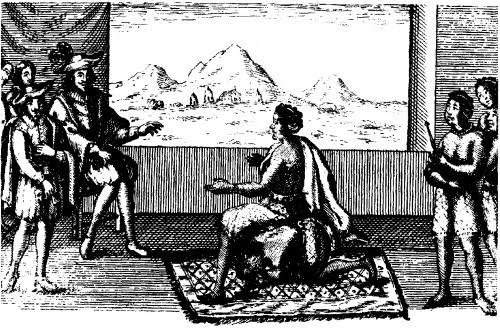
In 1622, a Portuguese governor refused to give her a chair. So she had one of her own attendants get down on their hands and knees, sat on their back, and negotiated as an equal anyway. She was not finished making that point for another four decades.
There is a single image that historians keep returning to when they try to explain who Nzinga was.
Luanda, 1622. The Portuguese governor João Correia de Sousa has arranged a formal meeting. He sits in a chair — an ordinary courtesy for a European official meeting a foreign dignitary. For Nzinga, representing the Kingdom of Ndongo as her brother's envoy, he has arranged nothing. A mat on the floor. The clear implication: you will negotiate looking up at me.
Nzinga did not sit on the floor.
She motioned to one of her attendants, who knelt down on hands and knees. She sat on the attendant's back, at eye level with the governor, and conducted the negotiation as one head of state addressing another.
It is a small, precise, devastating act of political theatre. And it tells you almost everything you need to know about the woman who would spend the next four decades doing, at increasing scale, exactly what she did in that room — refusing every attempt to make her smaller than the people trying to take her land.
The Kingdom Under Threat
Nzinga was born around 1583 into the royal family of Ndongo, a kingdom of the Mbundu people in what is now northern Angola. Her father was Ngola Kiluanji, the ruling chief — the word Ngola is where the modern nation of Angola gets its name.
She grew up inside a kingdom already under siege.
The Portuguese had established a colonial foothold at Luanda on the Angolan coast in the late 1500s, and by the time Nzinga reached adulthood, colonial expansion was tearing through Ndongo's social and political structures. Portugal's primary interest was not territorial administration in the way European colonialism would later operate elsewhere. It was people. Ndongo sat at the centre of one of the most active slave-trading regions on the West African coast, and Portuguese forces pursued it with escalating violence.
Nzinga's brother, Ngola Mbandi, inherited the throne and inherited the crisis alongside it — a kingdom being steadily drained of its population, its sovereignty eroding with every Portuguese military advance. He sent his sister to negotiate. That decision, born of desperation, put Nzinga in the room with Correia de Sousa in 1622 and set the entire remainder of her life in motion.
She negotiated well. She secured commitments from the Portuguese — the withdrawal of a fort, the return of captured Ndongo subjects, recognition of the kingdom's sovereignty. She even accepted Christian baptism as part of the diplomatic arrangement, taking the name Dona Ana de Sousa.
The Portuguese did not honour the agreement.
Taking the Throne
Ngola Mbandi died in 1624 under circumstances that remain disputed — some accounts suggest suicide brought on by the pressure of a collapsing kingdom, others suggest something more deliberate. What is certain is that Nzinga moved immediately to claim the throne.
This was not a simple succession. Ndongo had no tradition of female rulers. Nzinga's claim faced resistance on exactly those grounds, compounded by questions about her mother's status within the royal lineage. She took the male title of Ngola rather than a feminine equivalent, and she began, deliberately and publicly, to adopt customs associated with male leadership — military dress, symbols of martial authority, the language of a warrior rather than a diplomat's wife.
This was not eccentricity. It was strategy. In a political culture that did not recognise women as legitimate sovereigns, Nzinga built a version of herself that the existing structures of legitimacy could not easily reject.
It worked, but only partially and only for a time. The Portuguese, recognising an opportunity, backed a rival claimant to the Ndongo throne and pressed their military advantage. By 1626, Nzinga had lost control of Ndongo itself.
Most rulers in her position would have been finished. She had lost her capital, her throne, and the kingdom she was born to inherit.
She spent the next several years proving that losing a kingdom was not the same as losing a war.
The Alliance With the Imbangala
Between 1626 and 1631, Nzinga did something that reveals the sheer strategic range she operated with.
She allied herself with the Imbangala — bands of warrior mercenaries who operated outside the traditional Mbundu political structure, feared across the region for their military effectiveness and their willingness to fight for whoever offered the best terms. The Imbangala had previously fought alongside Portuguese forces in earlier campaigns. Nzinga brought them to her side instead.
With Imbangala military support, she moved against the neighbouring Kingdom of Matamba and conquered it between 1631 and 1635. Matamba, positioned further from the coast and further from the most intense pressure of Portuguese expansion, had its own tradition of female rulers — meaning Nzinga's claim to its throne faced none of the resistance she'd encountered in Ndongo.
She had lost one kingdom and built herself a new one, better positioned, from a standing start, using alliances that most of her contemporaries would have considered beneath a queen's dignity.
Once in control of Matamba, she did something that would define the rest of her reign: she opened her territory to anyone fleeing Portuguese-controlled land. Escaped enslaved people. Nobles displaced from Ndongo. Deserting African soldiers who had been trained and armed by the Portuguese and who Nzinga actively encouraged to switch sides, offering land and status in exchange for their loyalty.
Matamba became, under her rule, a kind of sanctuary state — and simultaneously a growing military threat that the Portuguese could not simply absorb or ignore.
The Dutch Alliance — Fighting Empire With Empire
In 1641, the political map of the region shifted dramatically. The Dutch West India Company seized Luanda from the Portuguese, part of a broader Dutch effort to challenge Portugal's colonial holdings across the Atlantic world.
Nzinga saw the opening immediately and moved to exploit it. She formed a military alliance with the Dutch — exchanging prisoners of war for firearms and naval support, entering into one of the earliest recorded African-European alliances explicitly formed against another European colonial power.
The partnership produced real results. Joint Dutch-Matamba operations struck Portuguese positions at Muxima and Massangano. In 1646, Nzinga's forces defeated the Portuguese directly at Kavanga, though the victory came at a personal cost — her sister Kifunji was captured during the campaign.
For seven years, the combined pressure of Nzinga's forces and Dutch military support kept the Portuguese on the defensive across the region in a way that no single African kingdom had managed to sustain against a European colonial power at that point in the Atlantic slave trade era.
Then in 1648, Portugal retook Luanda from the Dutch, and the alliance that had given Nzinga her strongest advantage collapsed with it.
The Long War of Attrition
Nzinga withdrew to Matamba and kept fighting.
For the next decade, Portuguese forces — reinforced at various points by mercenaries and by contingents from the rival Kingdom of Kongo — launched repeated campaigns against her. She was, by this point, in her sixties. She led her troops into battle personally, well past the age when most rulers, male or female, would have delegated command entirely to subordinates.
Portuguese campaigns throughout the 1650s failed to defeat her.
Not "struggled against her." Failed. An empire that had successfully colonised vast stretches of the Atlantic coast, that ran one of history's most brutal and lucrative slave-trading operations, could not, after decades of dedicated military effort, remove one African queen from her throne.
Eventually, both sides had reasons to want peace that had nothing to do with military defeat. Portugal was engaged in an expensive war against Spain and wanted the slave trade through the region reopened rather than perpetually disrupted by conflict. Nzinga, aware of her age and increasingly focused on securing her legacy, was open to negotiated terms rather than endless war.
In 1657, Portuguese Governor Luiz Mendes de Vasconcelos signed a treaty with Nzinga that returned thousands of captives to her control and formally recognised her sovereignty over Matamba. She permitted Capuchin Catholic missions into her territory while continuing to observe traditional Kimbundu religious practices alongside them — a deliberate, characteristic refusal to let anyone force her into choosing only one identity.
She had negotiated an African kingdom's survival, on terms she helped set, against the same colonial power that had once refused her a chair.
The Final Years
Under the peace, Matamba flourished. Nzinga's capital, Santa Ana de Sousa, became a genuine trading hub, linking Ndembu merchants, Portuguese traders, and Brazilian commercial interests into a functioning economic centre that dealt with the Portuguese colony on something approaching equal terms rather than as a subjugated territory.
She spent her final years consolidating what she had built rather than expanding it further — securing succession, strengthening Matamba's institutions, ensuring that the kingdom she had fought for four decades to preserve would outlast her.
Nzinga died on December 17, 1663, in Matamba. She named her sister Barbara — sometimes recorded as Kambu — as her successor, deliberately bypassing the traditional Mbundu election process to ensure a smooth transition of power. Her tomb at the Capuchin mission in Matamba reflected the same duality she had maintained throughout her life — a fusion of Catholic ritual and Kimbundu ancestral tradition, refusing, even in death, to be claimed entirely by either world.
The Complicated Truth
Vumbi Ventures does not tell African history as uncomplicated triumph, and Nzinga's story does not allow for that anyway.
Her legacy is genuinely contested, and honest history requires sitting with that discomfort rather than smoothing past it. Nzinga fought Portuguese colonialism and the machinery of the transatlantic slave trade with everything she had for four decades. She also, in the course of that fight, participated in slave trading and slave raiding herself — a common practice among African political and military powers of the era, and one that does not sit comfortably alongside her reputation as an anti-colonial icon.
Some historians describe her, without contradiction, as both a resistance figure of extraordinary skill and a ruthless political operator willing to use the same brutal economic system she was ultimately fighting to keep out of her own territory.
This complexity doesn't diminish what she accomplished. It makes it more human. Nzinga was not a symbol manufactured for modern comfort. She was a seventeenth-century head of state operating inside a genuinely brutal political and economic system, making decisions with the tools that system made available, while simultaneously building one of the only sustained, multi-decade resistances to European colonial expansion that Africa produced during that entire era.
Why She Still Matters
When Angola fought its own war of independence against Portugal in the twentieth century — a conflict that finally ended nearly three centuries of Portuguese colonial rule in 1975 — Nzinga's name and image became a central symbol of the resistance movement. Angolan nationalists reached back across three hundred years and found in her exactly what they needed: proof that Portuguese rule had never been accepted without a fight, that resistance to colonialism in Angola had deep and legitimate historical roots.
Today, Angola marks December 10th as National Heroine Day in her honour. Statues of her stand in Luanda. She is known widely as the "Mother of Angola." In 2023, her life became the subject of a Netflix docudrama that introduced her story to a global audience many of whom had never encountered it before.
She remains what she was in that room in Luanda in 1622: proof that dignity is not something that can be granted or withheld by whoever happens to hold more military power in a given moment. It is something you take, and then you spend the rest of your life, if necessary, defending it.
Queen Nzinga's resistance echoes other extraordinary African rulers who defied outside powers. Read more:
- The Kingdom of Kush — The African Civilization That Conquered Ancient Egypt →
- Mansa Musa — The Richest Person Who Ever Lived →
Explore more untold African history at vumbiventures.com/blog


