
African history | Ancient African civilizations | Mali Empire | African libraries | Timbuktu manuscripts
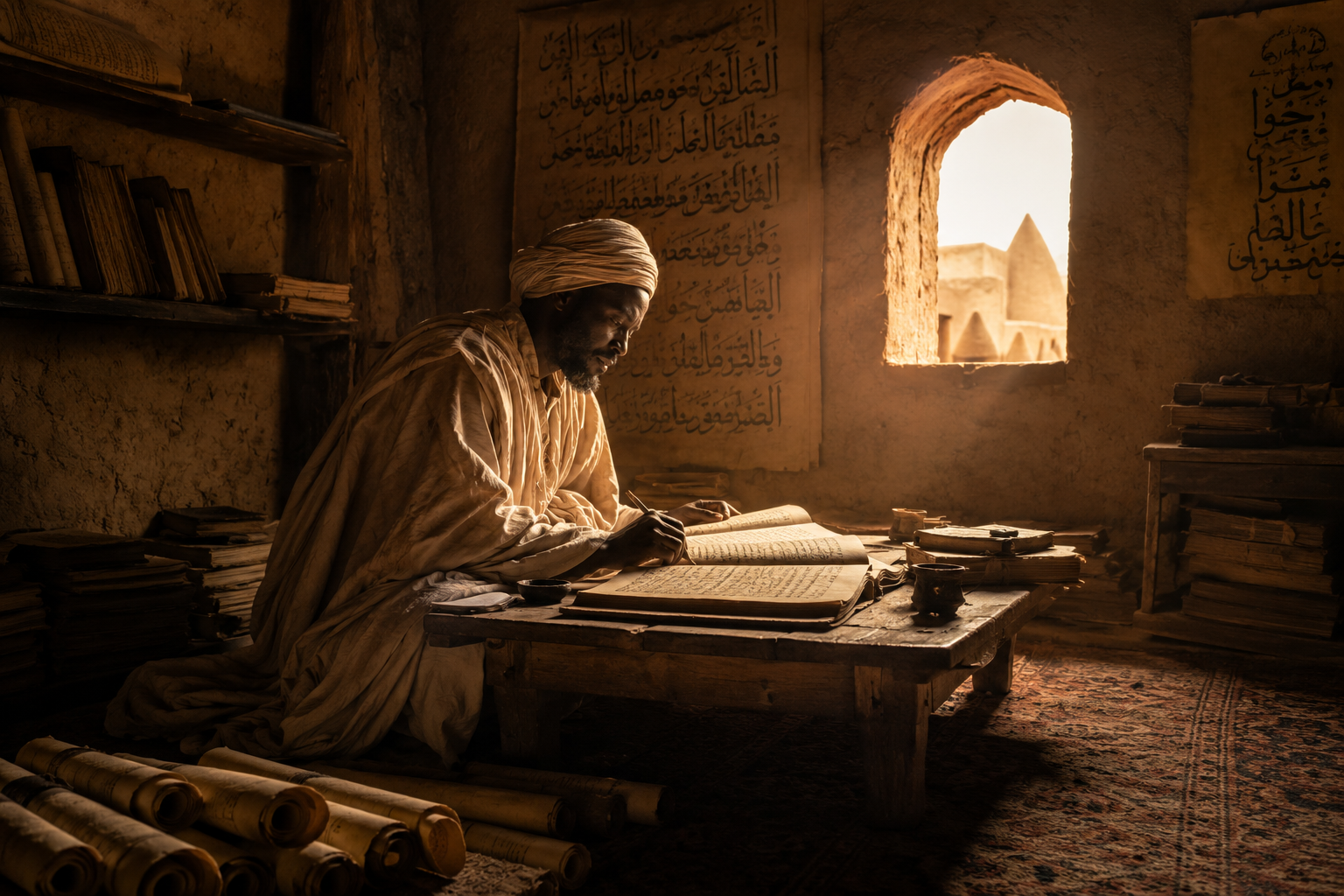
The sun rises slowly over the Sahara, painting the mud-brick walls of the city in shades of amber and rust. A scholar — robes trailing softly in the early morning dust — makes his way through narrow streets already alive with quiet purpose. Students gather beneath archways. The smell of ink fills the air. Somewhere nearby, a teacher recites from a manuscript so old that the edges have begun to curl like the petals of a dying flower.
This is Timbuktu. Not the punchline the Western world has made it. Not the mythical nowhere place invoked whenever someone wants to mean the ends of the earth. This is a city at the very center of the world — a city where knowledge was currency, where scholars were kings, and where a civilization so rich in learning that it still hasn't been fully understood was quietly flourishing.
At a time when Europe was still recovering from the Black Death, Timbuktu was home to one of the greatest universities the world had ever seen.
Most people have never been told this story. It's time they were.
Where in the World Is Timbuktu — And Why Does It Matter?
Timbuktu sits in present-day Mali, West Africa, on the southern edge of the Sahara Desert, just a few miles north of the Niger River. For centuries, this position made it not remote — but essential.
The city sat at the crossroads of the most important trans-Saharan trade routes in the ancient world. Caravans from the north brought salt, copper, and cloth. From the south came gold, ivory, and kola nuts. But something else traveled those routes too, something worth more than gold in the long run: ideas.
Timbuktu grew rich from trade. But it became legendary from knowledge.
By the 14th century, under the rule of the great Mali Empire — and later the Songhai Empire — Timbuktu had transformed from a trading post into an intellectual capital. At its height in the 15th and 16th centuries, the city's population rivaled many of the great cities of Europe. And roughly a quarter of those people — one in every four residents — were students.
Let that sink in.
The University at Sankore: Africa's Oxford
When people talk about the world's oldest universities, the same names come up: Bologna, Oxford, the University of Paris. Rarely does anyone mention Sankore.
Yet the Sankore Mosque in Timbuktu — built in the 14th century — functioned as one of the world's first and most sophisticated centers of higher learning. At its peak, Sankore and the surrounding complex of schools attracted scholars and students from across Africa, the Arabian Peninsula, Persia, and even parts of Europe.
The curriculum wasn't narrow or purely religious. Students at Sankore studied:
- Astronomy and mathematics — calculating celestial movements with a precision that astonished later European scholars
- Medicine and pharmacology — manuscripts detail diagnoses and treatments that predate many European medical texts
- Law and governance — producing jurists and administrators who shaped empires
- Philosophy and theology — debating ideas with the same rigor as any great thinker of the age
- Poetry, rhetoric, and the arts — because beauty, too, was considered worth mastering
Over 150 schools operated in the city at one time. The great mosque library at Sankore alone held thousands of texts. Families competed for the honor of housing the most manuscripts. Knowledge was not just respected in Timbuktu — it was worshipped.
The Manuscripts: Up to One Million Texts
Here is a number that should stop you in your tracks: historians estimate that between 700,000 and one million manuscripts once existed in Timbuktu.
Written mostly between the 12th and 20th centuries, and primarily in Arabic, these texts represented one of the most extraordinary archives of human thought ever assembled in one place. They covered everything from religious law and Quranic interpretation, to optics, astronomy, mathematics, romantic poetry, and philosophical debate.
Some manuscripts contain astronomical charts of breathtaking accuracy. One text references Ibn al-Haytham al-Baghdadi — an 11th-century polymath whose groundbreaking work in optics laid the foundations for what would later become the scientific method. Other manuscripts detail properties of light, mathematical tables listing positions of celestial bodies, and debates about moral philosophy that would feel at home in any modern university seminar.
There are manuscripts where scholars debate whether smoking tobacco was morally permissible. Others contain urgent letters reducing dowry requirements so that poorer men could marry. Marginal notes record earthquakes. Chronicles capture the rise and fall of empires that history textbooks have largely ignored. Scholars traced their intellectual lineage across generations — recording who taught whom in an unbroken chain of knowledge stretching back centuries.
These were not merely religious texts. They were the living record of a civilization thinking deeply about the world.
Ahmed Baba: The Scholar Africa Forgot
Every age has its towering intellect. In Timbuktu's golden age, that figure was Ahmed Baba al-Massufi al-Timbukti — born in 1556, died in 1627.
Ahmed Baba was, by any measure, one of the most prolific and influential scholars of his era. He is known to have written 56 works across disciplines including grammar, jurisprudence, theology, and history. Of those, 32 survive today. His most celebrated work, Nayl al-Ibtihaj bi Tatriz al-Dibaj, is a biographical dictionary of Muslim scholars — an indispensable record of West African intellectual history.
When the Moroccan army invaded and sacked Timbuktu in 1591, Ahmed Baba was among the scholars taken captive and transported to Morocco. Even in exile, he continued to teach and write. Students traveled from across North Africa to learn from him. He reportedly told his captors, bitterly, that the smallest library in his family's home in Timbuktu contained 1,600 books — and that he considered himself among the least learned of his peers.
Think about that. A man in chains, in exile, in a foreign land — and still the best-educated person in any room he entered.
Ahmed Baba eventually returned to Timbuktu, where he continued teaching until his death. The city's great research institute — the Ahmed Baba Institute — was named in his honor. It would later become the center of one of the most dramatic rescues of cultural heritage in modern history.
The Invasion That Changed Everything
Timbuktu's golden age didn't end with a slow fade. It ended with an army.
In 1591, the Saadian dynasty of Morocco dispatched an armed force across the Sahara — a grueling 135-day march through some of the world's most unforgiving terrain — to seize Timbuktu's wealth. They carried gunpowder weapons. The defenders of Timbuktu, armed with bows and spears, had little chance.
The Moroccan forces pillaged the city. They seized gold, destroyed infrastructure, and — crucially — carted off many of Timbuktu's most esteemed scholars in chains, along with countless manuscripts. The intellectual ecology of the city was shattered. Scholars fled. Families hid their libraries. The great university at Sankore never fully recovered its former glory.
But the knowledge didn't disappear. It went underground.
For the next four centuries, families in Timbuktu quietly preserved their manuscript collections — tucked in traditional wooden chests, wrapped in cloth, hidden in cellars and attics. Passed from parent to child. Protected not by governments or institutions, but by ordinary people who understood, in their bones, that these pages were sacred.
"It is traditional," one account notes, "for a family member to swear publicly that he will protect the library for as long as he lives."
2012: The Rescue That the World Almost Missed
In March 2012, Mali plunged into crisis. A military coup in the south was followed by armed Islamist groups — connected to al-Qaeda — seizing control of northern Mali, including Timbuktu.
The occupiers immediately began destroying the city's cultural heritage. UNESCO-protected shrines and mausoleums were smashed. The great door of the Sidi Yahya Mosque — said to bring apocalypse upon opening — was broken down as an act of symbolic defiance. Cultural memory was being erased in real time.
And then someone in the rebel leadership discovered something: the manuscripts of Timbuktu were on the UNESCO World Heritage list. To the jihadists, that made them a target.
What happened next is one of the most extraordinary acts of cultural heroism in modern history.
Abdel Kader Haidara — curator of the Mamma Haidara Commemorative Library, a position his family had held for generations — quietly began organizing a rescue. Working with local scholars, librarians, and a network of ordinary Timbuktu residents, Haidara coordinated the evacuation of hundreds of thousands of manuscripts out of the occupied city.
They were hidden in rice sacks. Packed into metal boxes. Loaded onto donkey carts and canoes on the Niger River. Carried by motorcycle and four-wheel drive vehicles. Smuggled past checkpoints under crates of fruit and vegetables.
The operation ran for eight months — from June 2012 to January 2013 — under constant threat of discovery. Roads were dangerous. Bandits and rebels patrolled the routes. In the south, a coup d'état created its own chaos. Every day of the mission was a gamble.
When French and Malian forces finally liberated Timbuktu in January 2013, the fleeing jihadists committed one last act of destruction: they torched the Ahmed Baba Institute, burning over 4,000 manuscripts, some dating to the 13th century.
But the rest were already safe. Haidara's team had smuggled an estimated 350,000 manuscripts to Bamako, Mali's capital — nearly 95% of Timbuktu's entire written heritage. The most valuable manuscripts had been hidden in the Institute's basement. The jihadists, in their haste, never looked down.
The world exhaled.
What Survived — And What It Tells Us
In 2025, thirteen years after the occupation, the manuscripts finally began returning home. Flown back to Timbuktu by plane, packed in more than 200 crates weighing over five tons, they arrived to a city that had never stopped waiting for them.
Today, the Ahmed Baba Institute is once again open. Staff catalog, preserve, and teach. Digitization projects — led by institutions including the Hill Museum & Manuscript Library in Minnesota and the British Library's Endangered Archives Programme — are making thousands of texts available online for the first time. Over 150,000 manuscripts have already been photographed.
What researchers are finding continues to rewrite what we thought we knew.
Among the surviving manuscripts: medical texts diagnosing diseases with clinical precision. Legal debates about governance and human rights. Mathematical treatises. Astronomical charts. A text on the properties of light that cites scholarship from across three continents. Poetry. Love letters. Records of earthquakes no one else thought to write down.
And through it all, running like a thread through every page: the unmistakable signature of a civilization that was not primitive, not backward, not waiting to be discovered — but actively, brilliantly, beautifully alive.
Why This Story Was Buried — And Why You Need to Know It
There is a persistent myth, still alive in textbooks and popular imagination, that Africa had no written history before European contact. That it was a continent of oral tradition and simple structures, waiting for the modern world to arrive.
Timbuktu is the refutation of that myth.
Not just symbolically. Literally. In ink. On pages that survived invasions, occupations, desert heat, and the deliberate rage of people who understood, perhaps better than anyone, that destroying a civilization's books is the surest way to erase its memory.
The manuscripts of Timbuktu are proof that Africa's intellectual tradition is ancient, documented, and extraordinary. They are proof that the "Age of Exploration" narrative — the one where knowledge flows from Europe outward to the world — is incomplete at best, dishonest at worst.
They are proof that somewhere in the Sahara, centuries before most of the world caught up, a city of scholars looked up at the same stars, asked the same questions, and wrote down the answers.
The Story Isn't Over
Many manuscripts remain in family libraries across Timbuktu, held in wooden chests, preserved with care but without funding. Some families, struggling financially, face pressure to sell privately — which risks scattering the collection permanently.
The digitization work continues. The Institute continues to train local specialists. The chain of teaching, recorded in the manuscripts themselves — scholar to student to scholar across generations — is still being documented, still being honored.
Timbuktu is not the end of the earth. It never was.
It is, as one of its own natives put it, a beginning.
Explore more untold stories of Africa's extraordinary history on Vumbi Ventures. Next: The Real Story of the Kingdom of Kush — The African Empire That Rivaled Egypt.


