There are fewer than 1,100 mountain gorillas left on earth. More than half of them live in this forest. Here is everything you need to know before you go.
The briefing happens at dawn.
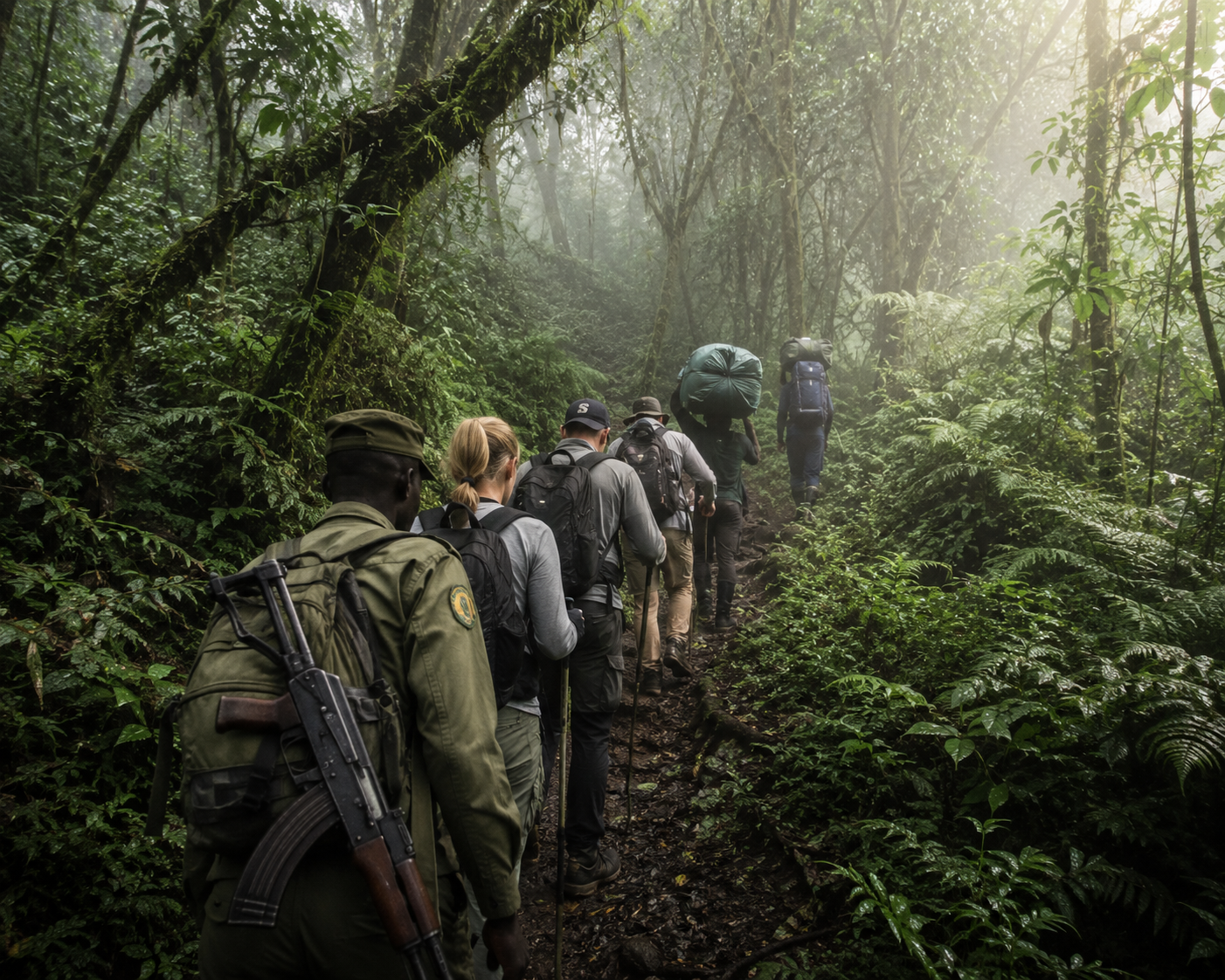
You're standing in a clearing at the edge of the forest with a small group — eight people maximum, the strict limit per gorilla family — while a Uganda Wildlife Authority ranger explains what is about to happen. The rules. The distances to maintain. What to do if a silverback charges. How to lower your eyes if a gorilla looks directly at you. How to move slowly and quietly through terrain that is about to become very steep, very muddy, and very beautiful.
You've been walking for perhaps an hour when the ranger ahead of you stops and raises his hand.
He points.
Twenty metres away, sitting in a shaft of light falling through the forest canopy, is a mountain gorilla. She is eating leaves with the focused concentration of someone who has nowhere else to be. She glances at you once — briefly, without alarm — and returns to her breakfast.
You have one hour. Nothing else exists.
Why Bwindi Is Unlike Anywhere Else on Earth
Bwindi Impenetrable National Park is one of Africa's most biodiverse ecosystems — a montane rainforest that has existed continuously for over 25,000 years, surviving the ice ages that stripped vegetation from most of the continent. It sits in Uganda's southwestern corner, straddling the border with the Democratic Republic of Congo, rising from 1,160 to 2,607 metres above sea level.
Bwindi Impenetrable Forest is home to over 19 habituated gorilla families spread across 4 sectors. Beyond the gorillas, Bwindi tours also give access to 90 mammal species and 11 primates including the black and white colobus monkey.
But the gorillas are the reason people come from every corner of the world to stand in this forest at dawn.
Because gorillas share approximately 98.4% of human DNA, even a common cold can prove fatal to them. That biological closeness — that almost uncomfortable proximity to our own species — is part of what makes the encounter so profound. You are not watching an animal at a safe distance. You are meeting something that looks back at you with recognition.
The 2026 Permit System — Everything Has Changed
Before you book anything, understand the current permit system — because as of March 1, 2026, the "soft hold" is a thing of the past. Previously, operators could reserve a permit for 7 days without payment. Now, full payment is required immediately to secure a permit.
This matters for planning. You can no longer tentatively hold a date while you sort out flights and accommodation. The moment you identify your preferred trekking date, you need to pay in full to secure your spot.
Standard Permit Costs 2026
Gorilla trekking in Bwindi Impenetrable National Park and Mgahinga Gorilla National Park 2026/2027 costs $800 USD per person for foreign non-residents, $700 USD per person for foreign residents, and $500 USD per person for Africans.
New Low Season Discount — 2026
In February 2026, the Uganda Wildlife Authority announced the formal introduction of discounted low-season gorilla permits. During Uganda's officially designated low-season months — April, May, and November — foreign non-residents can now secure a standard gorilla trekking permit for $600, a saving of $200 on the standard rate. There is one important caveat: low-season permits are non-reschedulable.
Habituation Experience
For USD $1,500 per person, you get to spend up to four hours with a semi-habituated gorilla family. You'll join researchers and rangers as they gently accustom a gorilla group to human presence. This is only available in the Rushaga sector.
Why the Permit Costs What It Costs
Revenue from gorilla trekking directly funds the management of Bwindi Impenetrable and Mgahinga national parks, supports anti-poaching ranger patrols, and provides livelihoods for local communities, giving those communities a direct financial incentive to protect rather than encroach on gorilla habitat.
The $800 is not just an entry fee. It is conservation funding. Without it, the gorillas would not exist.
Search and compare gorilla trekking packages to Uganda →
The Four Sectors — Which One Is Right for You
You no longer book a specific gorilla family. Instead, you book one of the four sectors in Bwindi. Understanding the difference between them is essential — your choice determines your experience, your accommodation options, and how hard you'll work to find your gorillas.
Buhoma — The Classic Sector (North)
Buhoma is the "classic" sector with luxury lodges and gentler trails. This is where gorilla trekking in Bwindi began — the original sector, the most developed, and the easiest to reach from Kampala. It's the best option for first-time trekkers, older visitors, or anyone who wants comfortable infrastructure alongside the experience.
The trails here are the most established and generally the least demanding — though "least demanding" in Bwindi still means several hours of uphill walking through dense forest.
Best for: First-time visitors, luxury travellers, those wanting reliable infrastructure.
Ruhija — The Birdwatcher's Sector (East)
Ruhija sits at high altitude with cooler air and is a favourite for birdwatchers. Bwindi is home to over 350 bird species including 23 Albertine Rift endemics found nowhere else on earth. If gorilla trekking is your primary goal but you want to combine it with extraordinary birding, Ruhija rewards that combination.
The high altitude means cooler temperatures — bring layers.
Best for: Birdwatchers, wildlife photographers, those wanting fewer tourists.
Rushaga — The Largest Sector (South)
Rushaga has the most habituated gorilla families in Bwindi — making it statistically your best chance of a successful encounter. It is also the only sector where the Gorilla Habituation Experience is available — giving you up to four hours with a semi-habituated family instead of the standard one hour.
The main challenge is the mud, as trails become slick and more difficult to navigate. Interestingly, gorillas often stay at lower elevations during this time, which can sometimes lead to shorter treks.
Best for: Those wanting maximum time with gorillas, serious wildlife enthusiasts, the Habituation Experience.
Nkuringo — The Most Dramatic Sector (South)
Nkuringo offers the most dramatic views and the steepest, most athletic hikes. The landscape here is extraordinary — deep valleys, volcanic ridges, views across into the DRC. But the terrain is genuinely challenging. Come fit and come prepared.
The reward for the extra effort is some of the most spectacular scenery in Uganda alongside your gorilla encounter.
Best for: Fit, adventurous trekkers who want drama with their wildlife.
What the Trek Is Actually Like
Nobody tells you quite enough about how physically demanding gorilla trekking can be. Let me be honest.
You will start early — briefings typically begin at 7:30–8am at the sector headquarters. Your group of eight will be assigned a ranger guide and armed rangers for security. Before you enter the forest, you are reminded of the rules:
- Stay at least 7 metres from the gorillas at all times
- Do not eat or drink in their presence
- Do not use flash photography
- Lower your gaze if a gorilla makes direct eye contact
- If a silverback charges — and it sometimes happens — do not run. Crouch slowly, look down, and let the ranger handle it
Then you enter the forest.
The trails range from 30 minutes to 8 hours of walking depending on where the gorilla family has moved. You will not know in advance. Rangers track the families' overnight nesting positions at dawn and relay information to your guide, but gorillas move and the forest is vast.
The terrain is steep, wet, and dense — this is called Impenetrable for a reason. You will use your hands as much as your feet on steep sections. A porter — available for hire at $15–20 — is worth every cent for carrying your bag and steadying you on the difficult sections. Do not be proud about the porter.
When you find your gorilla family — and you will find them, the success rate at Bwindi is extremely high — you have exactly one hour. Cameras out. Breathe. Watch.
Silverbacks weigh up to 220 kilograms and move through the forest with a quiet authority that makes you immediately understand why their presence commands respect. Infants tumble through branches and occasionally approach the human group with the fearless curiosity of very young things. Mothers nurse. Juveniles play. The entire family conducts its morning as if you are simply part of the forest — present but unremarkable.
That normalcy — being accepted as unremarkable by something this extraordinary — is the part that stays with you longest.
When to Go — The Honest Breakdown
Peak Season — June to September and December to February
The best time to trek is June–September and December–February. Drier trails, better photography conditions, and the most comfortable trekking weather. Permits sell out months in advance during these periods. Book 3–6 months ahead minimum.
Low Season — April, May and November
The wet season brings challenges — muddy trails, rain gear essential — but also rewards. Rain in Bwindi and Mgahinga rarely means all-day downpours; showers tend to be intense but brief. The forest remains trekable throughout, and the vegetation is at its most lush and dramatic. During the wetter months, gorillas also tend to descend to lower elevations to feed on fresh bamboo shoots, which can result in shorter trekking times.
And with the new $600 low-season permit — a $200 saving — the wet season now makes genuine financial sense for flexible travellers.
Where to Stay — Accommodation by Budget
Bwindi offers lodging for every style and budget.
- Budget: Expect to pay $50–$100 per person.
- Mid-range: Rates are typically $100–$300 per person.
- Luxury: High-end lodges range from $600–$1,500+ per person.
Budget Picks
Community-run rest camps around each sector headquarters offer basic but comfortable accommodation. They put money directly into local communities — a meaningful choice.
Mid-Range Picks
Comfortable safari lodges with full board meals, hot showers, and forest views. The standard experience for most visitors.
Luxury Picks
Clouds Lodge, Mahogany Springs, and Gorilla Forest Camp take the crown for luxury accommodation at Bwindi. These properties offer extraordinary service, stunning settings, and the kind of post-trek comfort that a day in Bwindi genuinely justifies.
Search and compare Bwindi lodges and accommodation →
Getting to Bwindi
Bwindi sits in Uganda's southwestern corner — about 8–9 hours by road from Kampala on reasonable roads, or 1 hour by chartered flight to a nearby airstrip.
Option 1 — Self-Drive or Private Transfer
The road from Kampala passes through Uganda's spectacular landscapes — Queen Elizabeth National Park, the equator crossing, the tea plantations of western Uganda. If time allows, building this into a longer Uganda road trip is highly rewarding.
Option 2 — Chartered Flight
Aerolink Uganda operates scheduled and charter flights between Entebbe/Kampala and airstrips near Bwindi. Approximately $200–350 per person one way. Worth it if time is limited.
Option 3 — Tour Package
Most travellers book Bwindi as part of a Uganda safari package that handles all logistics — flights into Entebbe, transfers, accommodation, and permit booking. Tour operators typically add $60–$100 per permit as a service fee. However, if you're booking a full tour through them, they usually waive the permit fee.
Search and compare flights to Entebbe, Uganda →
Uganda vs Rwanda — The Honest Comparison
Many travellers consider both countries for their gorilla trek. Here is the honest comparison:
Uganda (Bwindi) Rwanda (Volcanoes NP) Permit Cost $800 $1,500 Trek Duration 1–8 hours 2–5 hours Time With Gorillas 1 hour 1 hour Habituation Option Yes — $1,500 No Luxury Lodges Excellent World-class Overall Cost Lower Significantly higher Accessibility More remote Easier from Kigali
Uganda offers the same core experience — one hour with mountain gorillas — at almost half the permit price. Rwanda offers unmatched luxury infrastructure and easier logistics from Kigali.
If budget matters, Uganda wins clearly. If you want to combine gorillas with Rwanda's extraordinary story and recovery, do both.
What to Pack — The Practical List
The rangers will tell you this at the briefing but here it is in advance:
- Waterproof hiking boots — not trail runners, proper ankle-support boots
- Long waterproof trousers — tucked into your boots against safari ants
- Long-sleeved shirt — lightweight, for scratching vegetation
- Rain jacket — always, regardless of season
- Garden gloves — for grabbing vegetation on steep sections
- Insect repellent — apply before entering the forest
- Water — 2 litres minimum
- Energy snacks — the trek can take all day
- Camera — no flash. A telephoto lens is useful but not essential
- Cash for your porter — $15–20, the best money you'll spend
Leave at the lodge:
- Strong perfumes or cologne — gorillas are sensitive to smell
- Bright colours — stick to earth tones, greens, browns
- Plastic bags — they rustle and disturb the forest
Beyond the Gorillas — What Else Uganda Offers
Bwindi alone justifies the trip. But Uganda rewards those who stay longer.
Kibale Forest National Park — the best chimpanzee trekking in Africa. Chimpanzee tracking in Kibale Forest National Park costs $150 permit. A two-day Bwindi gorilla trek combined with a Kibale chimp trek gives you two of the most extraordinary primate encounters on earth in a single trip.
Queen Elizabeth National Park — lions that famously climb trees, hippo launches along the Kazinga Channel, and one of Uganda's best game drives. Conveniently located between Kampala and Bwindi on the western road.
Lake Bunyonyi — described as one of Africa's most beautiful lakes, surrounded by terraced hillsides and small islands. Perfect for a recovery day after the trek.
Kampala — Uganda's chaotic, creative, endlessly interesting capital. Rooftop bars overlooking the city, excellent food, the Kasubi Tombs UNESCO site, and a nightlife scene that keeps going until the city decides it's done.
The Full Cost of a Bwindi Trip — Realistic Numbers
Budget Trip — 4 Days
- Gorilla permit: $800
- Accommodation (3 nights budget): $150–300
- Transport Kampala–Bwindi return: $100–150
- Porter: $20
- Meals and incidentals: $60–80
Total: approximately $1,130–$1,350
Mid-Range Trip — 5 Days
- Gorilla permit: $800
- Accommodation (4 nights mid-range): $400–800
- Transport or charter flight: $200–400
- Porter and tips: $40
- Meals and incidentals: $100
Total: approximately $1,540–$2,140
Luxury Trip — 5 Days
- Gorilla permit: $800
- Accommodation (4 nights luxury): $2,400–6,000+
- Charter flights: $600–800
- All inclusive meals and services: included
Total: $3,800–$7,600+
Is It Worth It?
Here is the question every person asks before spending $800 on a one-hour experience.
Yes. Without reservation.
Not because the gorillas are spectacular — though they are. Not because Bwindi is beautiful — though it is. But because of what happens in that hour that is very difficult to explain to someone who hasn't experienced it.
You are in a forest that has existed for 25,000 years, watching a creature that shares 98% of your DNA live its morning in complete freedom. The silverback does not perform for you. The mother does not acknowledge you. The infant that toddles toward your group does so out of pure curiosity and retreats when it loses interest.
You are not the point. You are a visitor. And for one hour, that is exactly the right thing to be.
People who have done it describe it consistently the same way: like something shifted. Like a perspective that cannot be unshifted.
Go.
Bwindi pairs perfectly with Rwanda for a complete East African primate and history experience:
Plan your complete East Africa safari at vumbiventures.com


