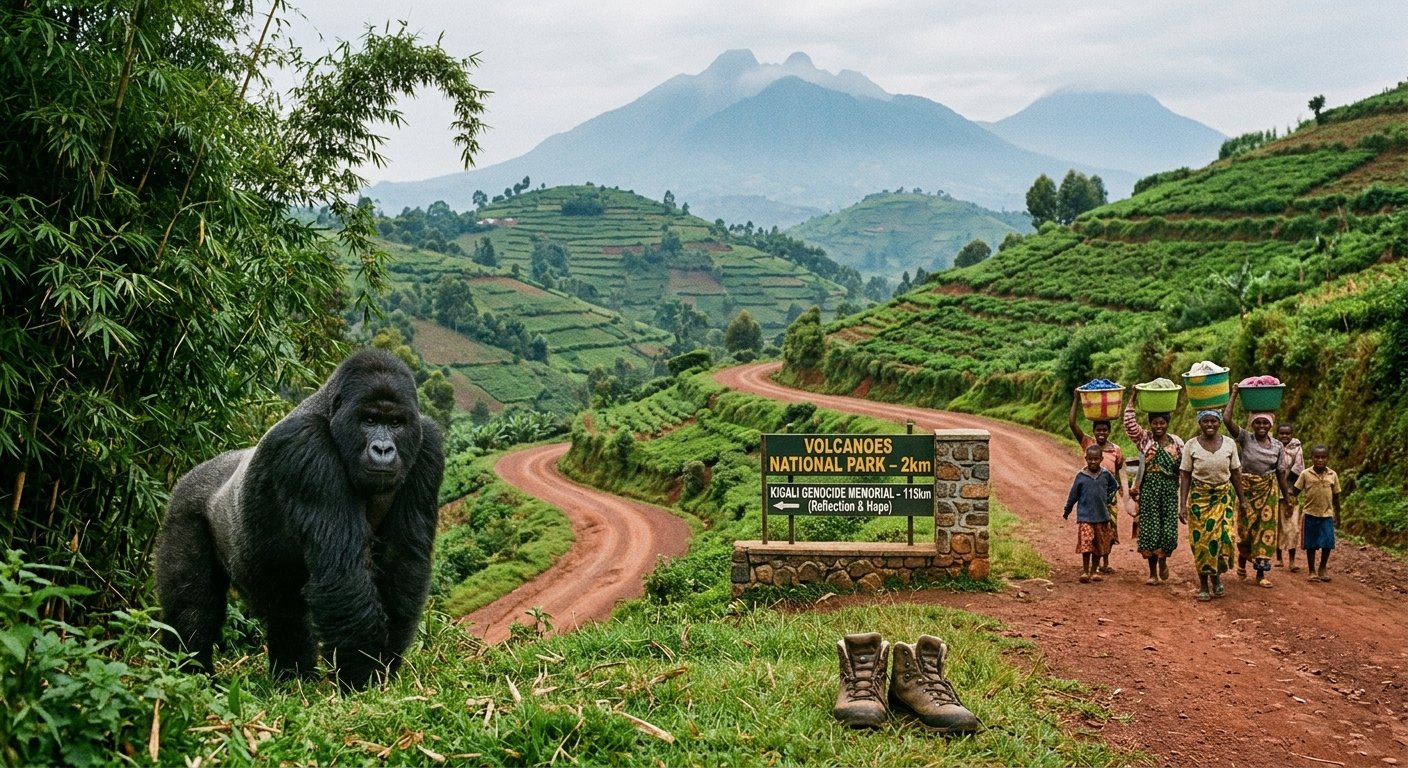
One country asks you to spend $1,500 for a single hour with a gorilla family. The same country lets you walk through the story of its darkest year for free. Both experiences will change how you think about what a nation can survive.
Key Facts
Capital Kigali Gorilla Permit Cost $1,500 USD per person (nearly double Uganda's $800) Daily Budget (non-gorilla) $50–80 budget · $100–150 mid-range · $500+ luxury Visa Visa-free for African nationals · eVisa for most other nationalities Best Time for Gorillas June–September and December–February (dry seasons) Getting There Fly into Kigali International Airport (KGL) Genocide Memorial Entry Free (donations encouraged) Nickname "Land of a Thousand Hills"
There are two Rwandas you'll encounter on the same trip, and neither one prepares you for the other.
The first Rwanda is Kigali on a Tuesday morning — clean streets, functioning traffic lights, a skyline that includes a genuinely striking convention centre, motorbike taxis weaving past cafes serving better coffee than you expected. It's one of the most orderly, safe, walkable capital cities anywhere in East Africa.
The second Rwanda is standing inside the Kigali Genocide Memorial two hours later, reading names, looking at photographs, understanding in a way that no textbook ever fully communicated what happened here in 1994 and what it took to build the first Rwanda on top of it.
Most travel guides tell you about one Rwanda or the other. You need both stories to understand the country you're actually visiting.
Gorilla Trekking — The Reason Most People Come
Rwanda offers the most accessible mountain gorilla trekking anywhere on earth. From Kigali International Airport, it takes under three hours by road to reach Volcanoes National Park — a drive so manageable that same-day trekking, arriving and departing Kigali within a single day, is a genuine option for travellers on a tight layover.
The permit costs $1,500 per person — nearly double Uganda's $800 for what is functionally the same experience: one hour observing a habituated gorilla family in their natural habitat. That price difference is real, and it's worth understanding rather than just accepting.
The gap isn't about the gorillas being different or the experience being twice as good. It reflects Rwanda's deliberate positioning strategy — low volume, high value tourism, designed to fund conservation while limiting environmental pressure on the park. You're also paying, in part, for the country's shorter travel times and more developed luxury lodge infrastructure around Volcanoes National Park compared to Uganda's more remote, harder-to-reach Bwindi sectors.
Booking: Secure your permit 3–6 months in advance for 2026 travel, either through a licensed tour operator or directly via the Rwanda Development Board's Irembo platform. Permits routinely sell out during peak dry season.
Best time to trek: June–September and December–February offer the driest trails and most comfortable conditions. The wet season months bring lower crowds and dramatically greener landscapes, at the cost of muddier, more physically demanding trails.
What the day looks like: An early pickup from your Kigali or Musanze accommodation, a briefing at Kinigi park headquarters, then a trek ranging from under an hour to several hours depending on where the gorilla family has moved overnight. One hour with the gorillas once found. Return to your lodge, or straight back to Kigali if you've chosen the single-day option.
Search and compare Rwanda gorilla trekking packages →
Rwanda vs Uganda — The Honest Comparison
Since these two countries offer essentially the same core experience, the comparison matters for planning.
Feature Rwanda Uganda (Bwindi) Permit Cost $1,500 $800 Travel Time from Airport Under 3 hours 8-9 hours by road, or short charter flight Trek Duration Typically 1-4 hours 30 minutes to 8 hours Infrastructure More developed, more luxury lodges More varied, more budget options Best For Short trips, luxury travellers, limited time Budget-conscious travellers, longer safaris
If your time is genuinely limited — a business trip with one free day, a long layover, a shorter overall Africa itinerary — Rwanda's accessibility justifies the premium. If budget matters more than convenience and you have more days to work with, Uganda offers the same encounter for almost half the price.
Read our complete Bwindi Gorilla Trekking Guide →
The Kigali Genocide Memorial — What You Need to Know Before You Go
This is not a conventional tourist attraction, and Vumbi Ventures isn't going to write about it like one.
The memorial documents the 1994 genocide against the Tutsi, in which an estimated 800,000 to 1 million people were killed over roughly 100 days. It is also the burial site of more than 250,000 victims. Entry is free, though donations to the Aegis Trust, which maintains the site, are encouraged and worthwhile.
Allow a minimum of two hours. Most visitors need longer. The exhibits move chronologically — from the colonial-era construction of ethnic division between Hutu and Tutsi, through the genocide itself, to Rwanda's deliberate, sustained project of national reconciliation in the decades since. A room dedicated to children lost in the genocide is, by every visitor account, the section that stays with people longest.
Go in the morning, when you have the emotional capacity to sit with what you're seeing. Don't schedule anything demanding immediately afterward. Many visitors simply walk the memorial gardens in silence for a while before returning to the rest of their day.
Understanding this history isn't a detour from your Rwanda trip. It's the foundation that makes everything else about the country — the cleanliness, the safety, the sheer functional competence of Kigali — make sense. What you're looking at in modern Rwanda is a nation that decided, deliberately and collectively, what it would become after nearly destroying itself.
Kigali — More Than a Gateway City
Most gorilla trekking itineraries treat Kigali as a place to sleep before or after the main event. That undersells it considerably.
- Kimironko Market: Kigali's largest market — genuinely useful for understanding daily Rwandan life, and a good spot for fabric, produce, and a crash course in local bargaining etiquette.
- Repub Lounge: Part of Kigali's broader restaurant scene that has developed well beyond expectations for a city its size — modern Rwandan and pan-African cuisine sitting alongside international options.
- The Kigali Convention Centre: Features a distinctive domed silhouette lit in shifting colours at night, serving as an unofficial symbol of the country's post-genocide reconstruction.
- Nyamirambo: Neighbourhood offering a walking tour experience organised by a local women's cooperative that takes you through a genuinely lived-in area rather than a curated tourist version.
Beyond Gorillas and Kigali
- Lake Kivu: One of Africa's Great Lakes, forming Rwanda's western border with the DRC. Towns like Gisenyi and Kibuye offer beaches, boat trips, and a slower pace for warm-up or wind-down days.
- Nyungwe Forest National Park: Home to a canopy walkway suspended above the forest floor and one of the best chimpanzee trekking experiences in East Africa, at a fraction of the gorilla permit price.
- Akagera National Park: Rwanda's answer to a classic savanna safari near the Tanzanian border. A deliberate reintroduction programme has restored lions and rhinos, making it a great Big Five add-on.
- Golden Monkey Trekking: A genuinely underrated add-on within Volcanoes National Park itself, considerably cheaper than the gorilla permit and easily bookable during the same trip.
Sample Itineraries
3 Days — Gorillas Only
- Day 1: Arrive Kigali, explore the city, Genocide Memorial in the afternoon.
- Day 2: Transfer to Musanze, gorilla trek in Volcanoes National Park.
- Day 3: Morning golden monkey trek, return to Kigali, departure.
5 Days — Gorillas and Lake Kivu
- Days 1–2: Kigali and gorilla trekking as above.
- Days 3–4: Transfer to Lake Kivu (Gisenyi or Kibuye) for beach time, boat trips, and recovery.
- Day 5: Return to Kigali via a scenic route, departure.
7 Days — The Full Rwanda
- Days 1–2: Kigali, Genocide Memorial, city exploration.
- Day 3: Gorilla trekking in Volcanoes National Park.
- Day 4: Golden monkey trekking, transfer toward Nyungwe.
- Day 5: Canopy walk and chimpanzee trekking in Nyungwe Forest.
- Days 6–7: Akagera National Park for a savanna safari finish, return to Kigali.
What It Actually Costs
If gorilla trekking is your only reason for visiting, Rwanda is genuinely expensive, and there's no getting around the $1,500 permit fee. But treat that as a distinct, once-in-a-lifetime line item rather than a representative daily cost, because the rest of the country runs at a completely different price point.
Daily Budget Breakdown (Excluding Gorilla Permit)
Style Daily Cost Budget $50–80 Mid-range $100–150 Luxury $500+
Specific Costs Worth Knowing
- Guesthouse in Kigali or Musanze: $20–50/night
- Mid-range full-board lodge: $250–450/night
- Ultra-luxury eco-lodge (Singita Kwitonda and similar): $1,200+/night
- Local meal: $5–15
- Mid-range restaurant meal: $15–25
- Upscale Kigali dinner: $30–60
- Moto-taxi short ride: $1–2
- Public bus Kigali–Musanze: $3–5
- Private 4×4 with driver (Kigali to Musanze): $250–350 round trip
- Visa on arrival: $50 (or East Africa Tourist Visa bundle covering Kenya, Uganda, and Rwanda)
The honest conclusion: budget travellers who treat gorilla trekking as the singular splurge and plan the rest of the trip around Rwanda's genuinely affordable food, transport, and accommodation can travel well on $50–80 a day outside of that one expense.
Search and compare Rwanda accommodation →
Search and compare flights to Kigali →
Getting There and Getting Around
Flights: RwandAir has been steadily expanding its international route network, connecting Kigali to major hubs across Africa, Europe, and beyond. Ethiopian Airlines and Kenya Airways both offer reliable connections via Addis Ababa or Nairobi.
Visa: Rwanda operates a visa-free policy for all African nationals. Most other nationalities can secure an eVisa in advance or a visa on arrival for $50.
Getting around: Kigali itself is walkable and safe, with moto-taxis (best booked through the Yego app) and ride-hailing options. Shared taxis and public buses connect major cities affordably, while private vehicle hire with a driver is standard for reaching Musanze.
Why Rwanda Belongs on Your Africa List
Rwanda asks something unusual of a traveller. It asks you to hold two truths in the same trip — that this is a country whose recent history includes one of the darkest chapters of the twentieth century, and that this is simultaneously one of the cleanest, safest, most functional, and most quietly extraordinary countries to visit anywhere on the continent.
Neither truth cancels the other out. Understanding both is, in a real sense, the actual point of going.
You come for the gorillas. You stay because Rwanda has built something genuinely rare — a nation that looked directly at its worst possible version of itself and decided, deliberately, methodically, and against considerable odds, to become something else entirely.
FAQ: Rwanda Travel 2026
How much does gorilla trekking cost in Rwanda?
A gorilla trekking permit costs $1,500 USD per person in Rwanda, compared to $800 in neighbouring Uganda. The price reflects Rwanda's deliberate low-volume, high-value tourism model and its more accessible, developed infrastructure around Volcanoes National Park.
Is Rwanda expensive to visit?
Gorilla trekking specifically is expensive due to the $1,500 permit fee. Outside of that single experience, Rwanda is genuinely affordable, with budget travellers able to manage on $50-80 per day for accommodation, food, and local transport.
Do I need a visa to visit Rwanda?
All African nationals can enter visa-free. Most other nationalities can obtain an eVisa in advance or a visa on arrival for $50, including the East Africa Tourist Visa option covering Kenya, Uganda, and Rwanda together.
Is Rwanda or Uganda better for gorilla trekking?
Both offer the same core experience — one hour with a habituated gorilla family. Rwanda is more accessible (under 3 hours from the airport) and has more luxury infrastructure, at nearly double the price. Uganda is more budget-friendly with a wider range of accommodation options, at the cost of longer travel times to reach the park.
How long should I spend in Rwanda?
A minimum of 3 days covers gorilla trekking and Kigali. 5-7 days allows you to add Lake Kivu, Nyungwe Forest chimpanzee trekking, or Akagera National Park for a fuller picture of the country.
Is Rwanda safe to visit?
Yes. Kigali is widely regarded as one of the safest, cleanest capital cities in East Africa, and Rwanda overall has a strong reputation for safety and functional governance for tourists.
Rwanda pairs naturally with Uganda for a complete East African gorilla and primate experience:
Explore more East Africa travel guides at vumbiventures.com/blog


