
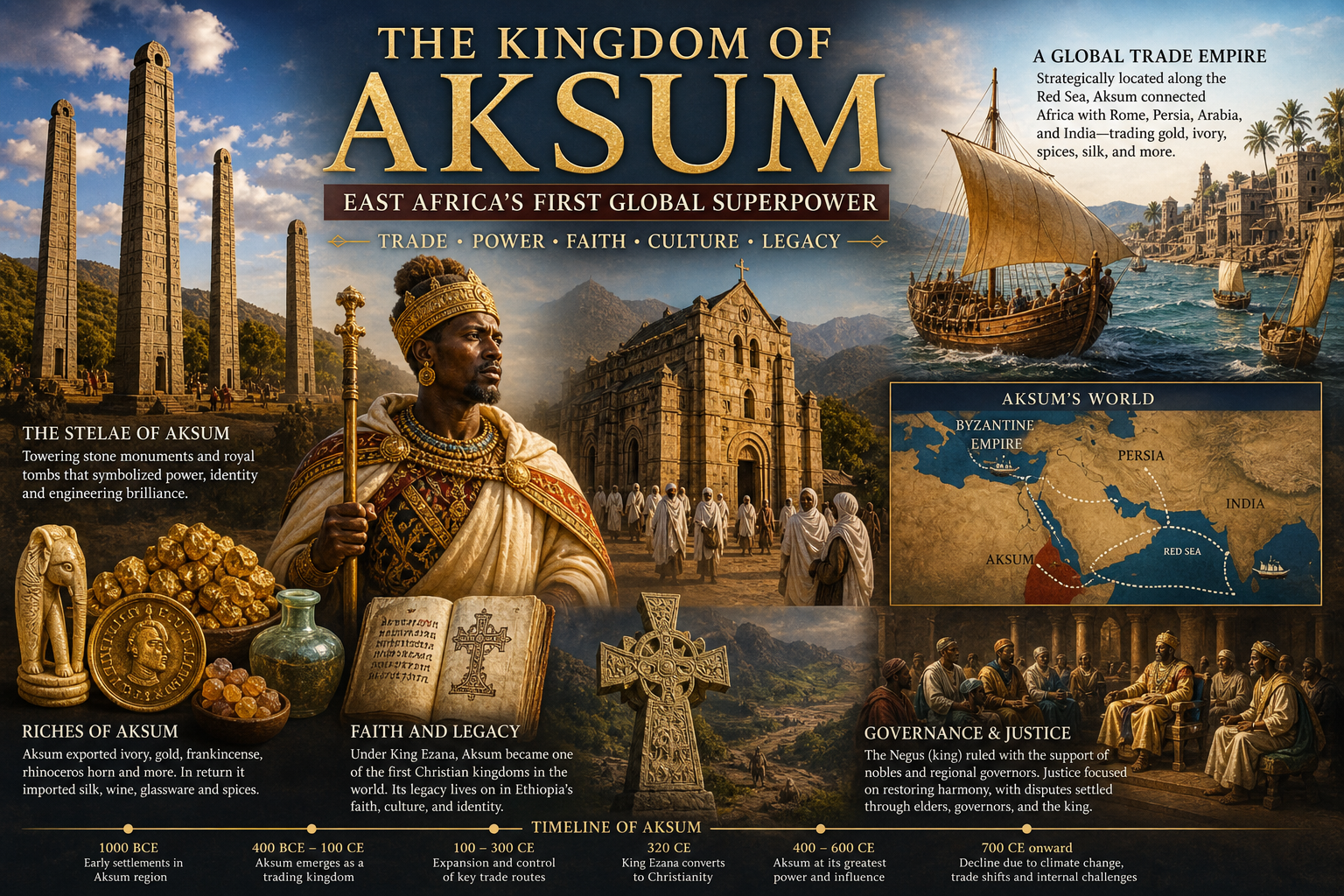
When most people imagine ancient global civilizations, they think of Rome, Persia, or Egypt. Yet along the Red Sea coast of the Horn of Africa, another empire quietly rose into the ranks of the world’s great powers. The Kingdom of Aksum became one of the most influential trading and political states of the ancient world, shaping the history of what is now Ethiopia and Eritrea, and influencing trade networks stretching from the Mediterranean to India.
This is the story of how Aksum formed, how it governed, the peoples who built it, and how it connected East Africa to the wider world centuries before colonial borders existed.
Why Aksum Matters in East African History
Before colonial names and modern borders, the region was a network of kingdoms, clans, pastoralists, farmers, and traders. Aksum stands out because it became:
One of the world’s earliest global trade empires One of the first Christian kingdoms A state with its own written language and currency A diplomatic power interacting with Rome, Persia, Arabia, and India
At its height (around 100–700 CE), Aksum was so powerful that Persian writer Mani listed it alongside Rome, Persia, and China as one of the four great civilizations of the world.
Geography: The Perfect Position for a Trade Empire
Aksum’s rise was not accidental. Geography shaped its destiny.
The kingdom sat near the Red Sea trade routes linking the Mediterranean world with the Indian Ocean trading system. Merchants sailing between the Roman Empire and India passed the Horn of Africa, making Aksum a natural commercial hub.
Key geographic advantages included:
Fertile highlands ideal for agriculture Access to Red Sea ports like Adulis Control of inland caravan routes connecting to the Nile and interior Africa
This location allowed Aksum to become the middleman of global trade.
The People Behind Aksum
Aksum was not built by one tribe but by a blend of cultures.
Main Ethnic and Cultural Groups Agaw peoples – early inhabitants of the highlands Semitic-speaking migrants from South Arabia – introduced new languages and scripts Cushitic pastoral communities across the region
The fusion of African and Arabian cultural influences produced the Ge’ez language, one of the world’s oldest written languages still used today in Ethiopian liturgy.
The Rise of a Trading Power
Aksum’s wealth came from trade. It exported valuable goods that were rare in the ancient world.
Major Exports Ivory Gold Rhinoceros horn Tortoiseshell Frankincense and myrrh Enslaved people (a harsh reality of ancient trade systems) Imports Silk from China Spices from India Glassware from Rome Wine and olive oil from the Mediterranean
Aksum minted its own gold coins, something very few African civilizations did. This made international trade easier and signaled economic sophistication.
Political Organization and Governance
Aksum developed a centralized monarchy led by a king known as the Negus (later “Negusa Nagast” — King of Kings).
Government Structure
1. The King (Negus)
Absolute political and military authority Considered divinely chosen Controlled trade, diplomacy, and religion
One of the most famous rulers was King Ezana, who transformed the kingdom forever.
2. Nobility and Regional Governors
Managed provinces Collected taxes and tribute Maintained order in rural territories
3. Military Commanders
Protected trade routes Conducted expansion campaigns Controlled Red Sea ports
The government was highly organized for its time, supported by written records and inscriptions.
Aksum’s Military Power
Trade made Aksum wealthy. Wealth funded armies.
The kingdom controlled:
Northern Ethiopia and Eritrea Parts of Sudan Southern Arabia (modern Yemen)
Aksum even intervened in Arabian politics to secure trade routes. Control of the Red Sea gave the empire naval influence, something rare in ancient African kingdoms.
Religion: From Polytheism to Christianity
Religion played a central role in governance and identity.
Early Beliefs
Before Christianity, Aksumites practiced polytheistic religions influenced by Arabian traditions. The chief god was Mahrem, associated with war and kingship.
Conversion to Christianity
In the 4th century, King Ezana converted to Christianity after being influenced by a missionary named Frumentius.
Aksum became:
One of the first Christian states in the world A major center of early African Christianity
This decision reshaped East African identity for centuries.
Christianity helped:
Unite the kingdom culturally Strengthen ties with the Byzantine Empire Create a shared moral and legal system Law, Justice, and Dispute Resolution
Like many African societies, justice focused on restoring harmony rather than punishment alone.
How Disputes Were Solved Local elders handled minor disputes Regional governors judged major conflicts The king acted as the supreme judge
Justice emphasized:
Compensation and reconciliation Restoring community balance Maintaining social order
This approach mirrored conflict-resolution traditions still found across East Africa today.
How Aksum Treated Foreigners
Aksum’s wealth depended on trade, so foreigners were essential.
Merchants from:
Rome Persia Arabia India
…were welcomed into trading cities.
Foreign traders were:
Allowed to live in port towns Protected by royal law Taxed but encouraged to trade
This openness turned Aksum into a cosmopolitan trading society long before globalization.
Architecture and Engineering: The Famous Stelae
Aksum’s most iconic structures are its giant stone obelisks (stelae).
These towering monuments:
Marked royal tombs Demonstrated engineering skill Symbolized political power
Some stelae reach over 24 meters tall and weigh hundreds of tons.
They remain among Africa’s greatest ancient architectural achievements.
The Beginning of Decline
No empire lasts forever. Aksum began declining around the 7th century.
Major Causes
1. Climate Change
Soil exhaustion and deforestation Reduced agricultural productivity
2. Trade Route Shifts
Rise of Islamic caliphates changed Red Sea trade networks Aksum became economically isolated
3. Internal Pressures
Overextension of territory Reduced political cohesion
Gradually, the kingdom retreated into the Ethiopian highlands, where its cultural legacy continued.
The Lasting Legacy of Aksum
Even after its political decline, Aksum shaped East Africa profoundly.
Its legacy includes:
The Ethiopian Orthodox Church The Ge’ez writing system Early African Christianity Trade traditions across the Horn of Africa
Aksum proved that East Africa was not isolated — it was deeply connected to the ancient world.
Why Aksum Still Matters Today
Understanding Aksum changes how we view African history.
It shows that East Africa had:
Complex states International diplomacy Advanced economic systems Rich cultural traditions
Long before colonial maps, powerful African civilizations were already shaping global history.
Up Next in This Series
This article is the first in a deep dive into East Africa’s great kingdoms. Next, we explore the powerful inland kingdom around Lake Victoria — the rise of Buganda.


