
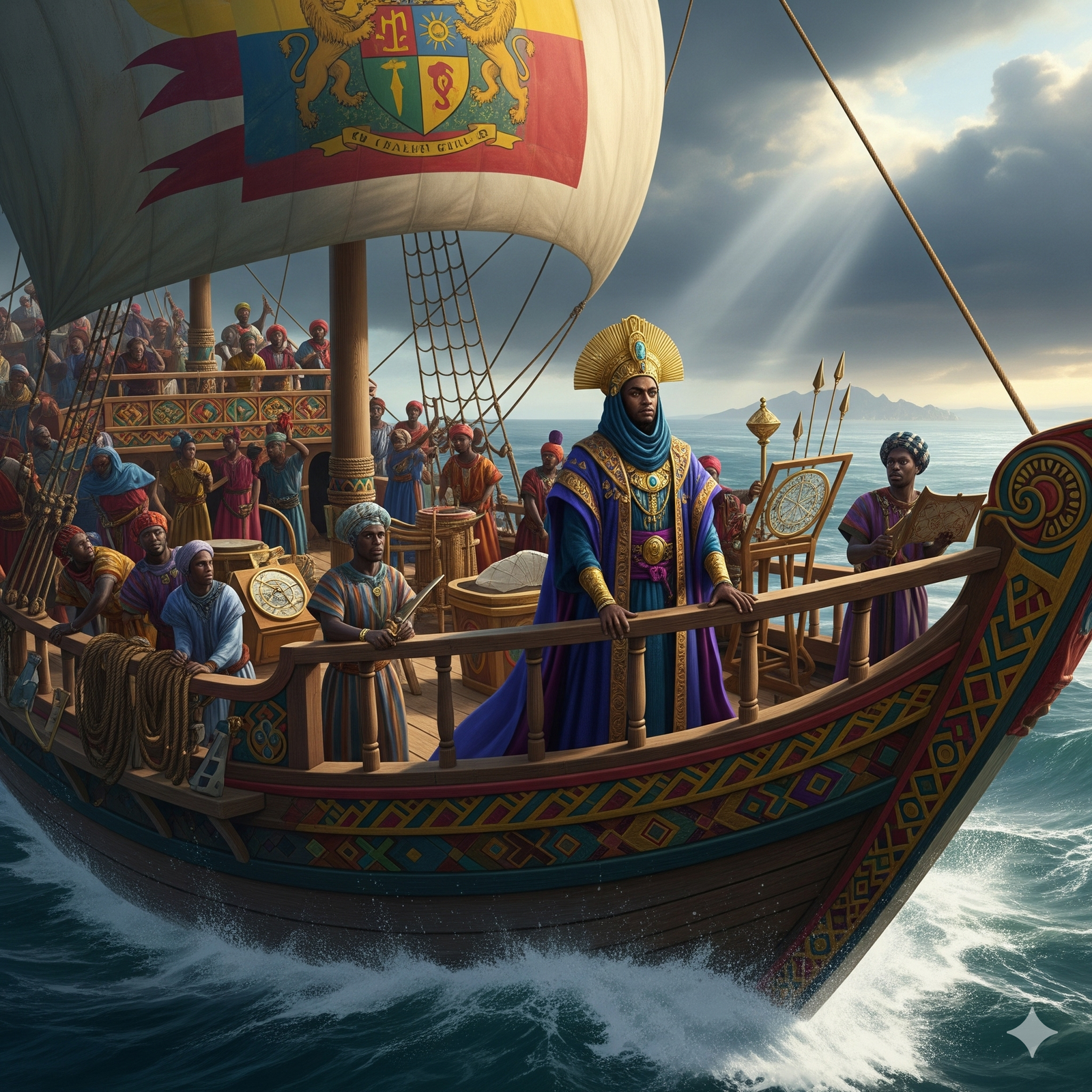
When people think of great explorers who crossed the Atlantic, names like Christopher Columbus and Vasco da Gama dominate the conversation. The common narrative begins in Europe's "Age of Exploration," painting Africans as passive bystanders until the arrival of ships bearing foreign flags.
Yet African history tells a very different story. More than a century before Columbus, an emperor of the Mali Empire — popularly remembered today as Mansa Abubakari II — is said to have launched a daring expedition across the Atlantic Ocean. With thousands of ships and men, he sought to uncover the mysteries of the horizon.
Though his journey ended in silence, his legacy challenges how we think about exploration, Africa's role in world history, and the myth of isolation.
This is the story of the emperor who gave up a throne of gold to chase the unknown — and of a name that history may have gotten wrong along the way.
The Mali Empire: Wealth, Power, and Knowledge
To understand this story, one must first understand the Mali Empire, a civilization that flourished in West Africa between the 13th and 16th centuries.
A Land of Gold
Mali was founded by Sundiata Keita after the Battle of Kirina in 1235. Over the next century, the empire expanded across much of West Africa, encompassing modern-day Mali, Senegal, Gambia, Guinea, Niger, and parts of Nigeria.
Mali controlled the trans-Saharan trade routes, where caravans carried salt from the Sahara southward and gold, ivory, and other goods northward. Gold dust was so common in Mali that it was used for ornaments, ceremonies, and international trade.
Cities of Knowledge
- Timbuktu became a center of Islamic learning with universities and vast libraries.
- Scholars studied astronomy, medicine, mathematics, and theology.
- Gao flourished as both a commercial hub and cultural center.
Mali's Maritime Potential
Although Mali was inland, its western borders stretched to the Atlantic coast. River systems like the Niger nurtured traditions of boatbuilding and navigation, laying the foundation for the bold voyage at the center of this story.
The Story, As Mansa Musa Told It
The entire account rests on a single conversation. In 1324, while passing through Cairo on his famous hajj pilgrimage, Mansa Musa — Mali's most celebrated emperor — befriended an Egyptian official named Ibn Amir Hajib, who asked him how he had come to the throne. Musa's answer was recorded by the Damascene historian Ibn Fadlallah al-Umari, and it remains the only source this entire story is built on.
According to al-Umari's account, Musa explained that his predecessor did not believe it was impossible to discover the furthest limit of the Atlantic Ocean, and wished vehemently to do so. That predecessor outfitted a fleet of 200 ships — half carrying men, half carrying gold, water, and provisions enough to last for years — and ordered its commander not to return until he reached the ocean's end or ran out of supplies. Only one ship came back. Its captain reported that the fleet had sailed until it reached what appeared to be a powerful current in the open sea; the other ships pressed on into it and were never seen again.
Unconvinced that the voyage had failed, the emperor abdicated the throne to Musa and set out himself with a second, far larger fleet — 2,000 ships this time, half carrying settlers and sailors, half carrying supplies, livestock, seeds, and tools. He was never seen again, and Musa became king in his own right.
A Name History May Have Gotten Wrong
Here is the detail most retellings of this story leave out: the name "Abubakari II," used throughout popular accounts including earlier versions of this one, does not appear to correspond to any Malian ruler who actually reigned.
Al-Umari's own record of Musa's account never names the predecessor at all — the only clue to his identity is that he came immediately before Musa. The "Abu Bakr II" name originates from a 19th-century mistranslation of the historian Ibn Khaldun's chronicle by the French orientalist Baron de Slane, who read the succession as passing from a ruler named Muhammad, to an intervening "Abu Bakr," to Musa. Later scholarship — particularly the historian Nehemia Levtzion's 1963 study of Mali's medieval kings — found that Ibn Khaldun's original Arabic text mentions Abu Bakr only as an ancestor in Musa's lineage, not as a ruler in his own right; the real Abu Bakr who once sat on Mali's throne reigned generations earlier, immediately before a usurper named Sakura, with no connection to this voyage at all.
So who did send the fleet? Since Ibn Khaldun records Musa's immediate predecessor as Mansa Muhammad, several historians attribute the voyage to him instead. Others have proposed Mansa Qu, Muhammad's own father. The honest answer is that nobody knows for certain — which is a genuinely interesting historical puzzle in its own right, even if it complicates the tidy version of the story that gave this figure a name.
None of this means the voyage itself is fictional. Al-Umari's account is treated as a serious, if singular, historical source. It just means the specific name most articles (including earlier drafts of this one) attach to the emperor is very likely a 200-year-old translation error that calcified into popular history.
Could He Have Reached the Americas?
This is where the story shifts from documented history into genuine speculation — and where the evidence gets considerably thinner.
1. Ocean Currents
The "powerful current" described by the surviving captain is generally identified by historians as the Canary Current, which does flow from West Africa toward the Americas — meaning a westward voyage was, in principle, physically possible, and Musa's account suggests some real awareness of Atlantic oceanographic conditions.
2. Columbus's Own Log
The strongest piece of circumstantial evidence comes from Christopher Columbus himself. An abstract of Columbus's log from his third voyage, preserved by the Spanish historian Bartolomé de las Casas, records that Columbus set out partly to test claims — made both by Portugal's King John II and by the native inhabitants of Hispaniola — that people had arrived from the south and east carrying spears tipped with an alloy the islanders called guanín. It's a striking detail, though it falls well short of proof of a completed Malian crossing more than a century earlier.
3. The Olmec Colossal Heads
This is the claim that most needs a caveat. The idea that Mesoamerica's Olmec stone heads reflect African features and therefore evidence of pre-Columbian African contact originates with Ivan Van Sertima's 1976 book They Came Before Columbus. It is not accepted by mainstream archaeology. A detailed rebuttal published in the journal Current Anthropology by researchers Gabriel Haslip-Viera, Bernard Ortiz de Montellano, and Warren Barbour concluded that no genuine African artifact has ever been found in a controlled archaeological excavation anywhere in the Americas. Karl Taube, a Mesoamerican art specialist at UC Riverside, has stated flatly that there is no material evidence of any contact between the Old World and Mesoamerica before the Spanish arrived in the 1500s. The Olmec heads are now understood by mainstream scholars as representing indigenous Mesoamerican rulers, not evidence of African arrival.
4. Archaeological Finds
Beyond the Olmec claim, occasional reports of West African-style metallurgy in South America have circulated, but none have held up to controlled archaeological scrutiny in the way the field requires before treating a find as genuine evidence of contact.
Skepticism and Debate
- No definitive settlements, artifacts, or genetic evidence of pre-Columbian African contact with the Americas have been found in any controlled excavation.
- Al-Umari's account is the only historical record of the voyage — it appears in no other Arab chronicle and in no West African oral tradition.
- The fleets most likely perished at sea. Regardless of whether any ship reached land, none returned to Mali, and the voyage had no discernible long-term economic or political consequences for the empire.
Legacy of the Story
Africa as an Agent of Exploration
Whatever the outcome of the voyage, and whoever actually commanded it, the episode is real evidence that Mali possessed the maritime ambition, shipbuilding capacity, and Atlantic awareness to attempt ocean exploration — undercutting the old narrative that Africa was isolated and passive before European contact.
The Power of Curiosity
An emperor abandoning immense wealth and a secure throne to chase an unanswered question about the edge of the world is, at minimum, a remarkable decision — one modern retellings, including a Malian praise-singing tradition still performed today, continue to honor.
Reframing History
The story — even stripped of the Olmec claims and told with the honest uncertainty around the emperor's real name — still challenges Eurocentric narratives and adds real texture to our understanding of medieval Mali's outward-facing ambition.
Conclusion: An Emperor Who Sailed into Mystery
The identity of this emperor remains genuinely disputed among historians — some point to Mansa Muhammad, Musa's actual predecessor by name; others to Mansa Qu; the popular "Abubakari II" is most likely a translation error from the 1800s that took on a life of its own. What isn't disputed is that Mansa Musa himself told the story of a fleet, sent by the ruler before him, that sailed into the Atlantic and never returned — and that the loss of that fleet is what put Musa on the throne in the first place.
Whether any ship ever reached the far shore, the deeper story here is still true: Africa was never the isolated, static continent the old textbooks described. It was building fleets and asking the same questions about the horizon that every seafaring civilization eventually asks.
Sources
- Levtzion, Nehemia, and Hopkins, J.F.P., eds. Corpus of Early Arabic Sources for West African History. Markus Wiener Publishers, 2000 — the standard English translation of al-Umari's account.
- Gomez, Michael A. African Dominion: A New History of Empire in Early and Medieval West Africa. Princeton University Press, 2018.
- Levtzion, Nehemia. "The Thirteenth- and Fourteenth-Century Kings of Mali." Journal of African History 4, no. 3 (1963): 341–353 — the study that identified the de Slane mistranslation behind the "Abu Bakr II" name.
- Thornton, John K. A Cultural History of the Atlantic World, 1250–1820. Cambridge University Press, 2012.
- Haslip-Viera, Gabriel, Bernard Ortiz de Montellano, and Warren Barbour. "Robbing Native American Cultures: Van Sertima's Afrocentricity and the Olmecs." Current Anthropology 38, no. 3 (1997): 419–441.
- Taube, Karl. Olmec Art at Dumbarton Oaks. Dumbarton Oaks Research Library and Collection, 2004.


