
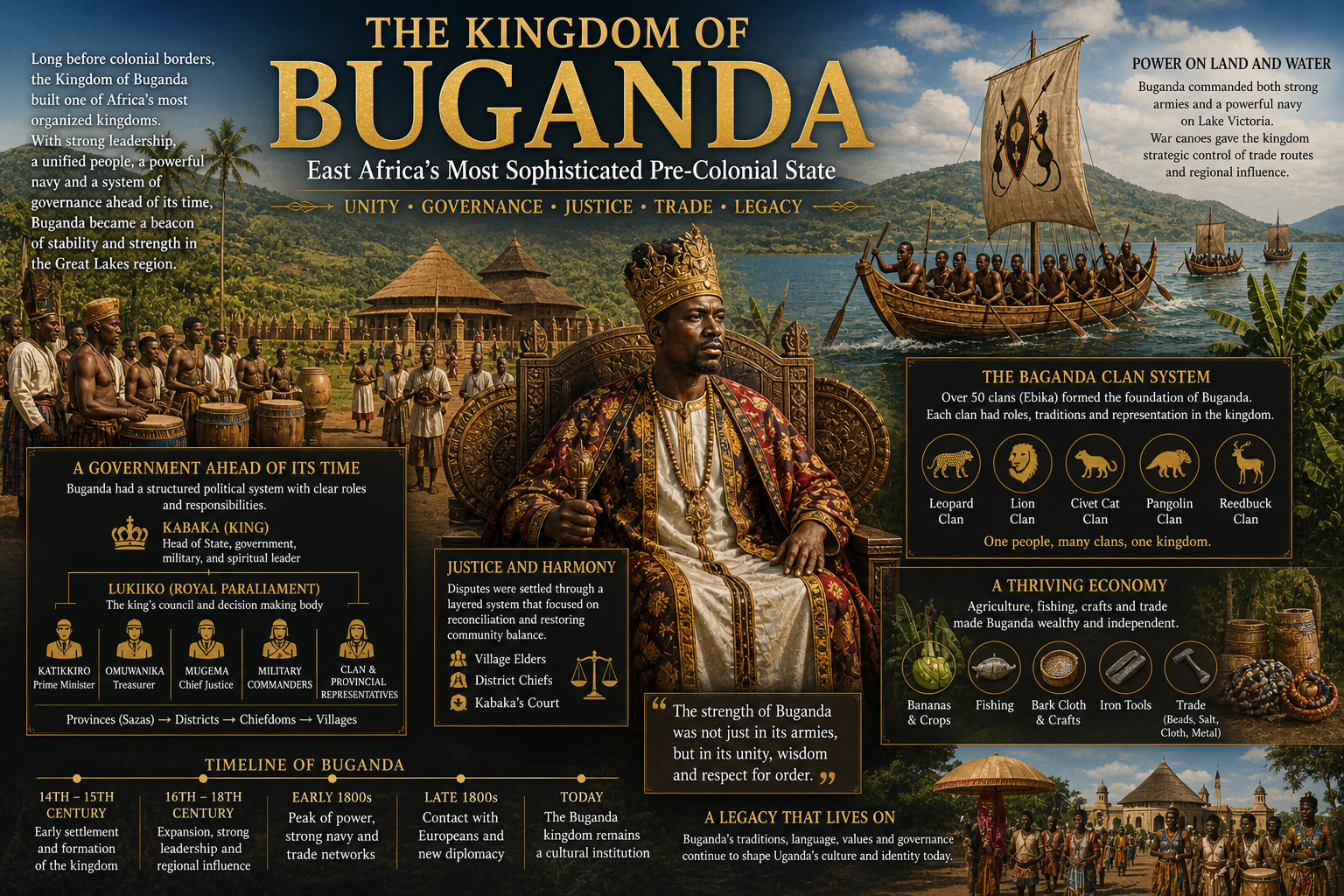
The Drumbeat That Announced a King
The sound could travel for miles.
Deep, rhythmic, unmistakable.
Across the green hills north of Lake Victoria, villagers would pause mid-task. Farmers lifted their heads. Fishermen stopped pulling nets from the water. Children ran toward their homes.
The royal drums were speaking.
And everyone understood the message:
A decision had been made at the king’s palace.
Long before colonial borders carved East Africa into modern countries, the Kingdom of Buganda had already built one of the most organized political systems on the continent. While many imagine ancient Africa as scattered tribes, Buganda was a centralized state with ministers, tax systems, courts, naval fleets, and one of the most efficient administrations in pre-colonial Africa.
This is the story of the kingdom that mastered governance, diplomacy, and power — and whose legacy still shapes modern Uganda today.
Where Was the Kingdom of Buganda Located?
The Kingdom of Buganda emerged in the region surrounding Lake Victoria, in what is today central Uganda.
Its strategic geography explains much of its rise:
• Fertile agricultural land • Access to freshwater and fish • Natural trade routes across East Africa • Dense population capable of supporting a large state
Buganda sat at the crossroads of regional trade networks linking the Great Lakes, the Nile Basin, and the East African coast.
Location created opportunity — but organization created power.
The People of Buganda: The Baganda
The citizens of the kingdom were known as the Baganda (singular: Muganda).
Buganda was not built by a single tribe in the narrow sense. Instead, it was a multi-clan kingdom unified under a central monarch.
The Baganda social system was built around clans (Ebika).
There were over 50 clans, each with its own identity, responsibilities, and cultural roles.
Examples of major clans included:
• Leopard clan • Lion clan • Civet cat clan • Pangolin clan • Reedbuck clan
Each clan had: • Totems • Traditions • Political responsibilities • Representation at the royal court
This clan system created a powerful national identity while preserving local heritage — a sophisticated balance of unity and diversity.
The Kabaka: Absolute Monarch of Buganda
At the center of Buganda’s power stood the Kabaka — the king.
But the Kabaka was not merely a symbolic ruler. He was:
• Head of government • Commander of the military • Chief judge • Spiritual leader • Owner of all land
Yes — in Buganda, all land technically belonged to the king.
However, governance did not rely on dictatorship. The Kabaka ruled through a structured administrative system that resembled modern governments.
A Government Ahead of Its Time
Buganda developed one of Africa’s most complex political systems before colonial rule.
The Kabaka governed through a council known as the Lukiiko — a royal parliament.
The Lukiiko included:
• Prime Minister (Katikkiro) • Treasurer (Omuwanika) • Chief Justice (Mugema) • Military commanders • Clan leaders • Provincial governors
This system ensured:
• Efficient decision making • Delegated authority • Regional representation • Administrative continuity
In modern terms, Buganda had the equivalent of:
Cabinet + Parliament + Judiciary.
How the Kingdom Was Organized
Buganda was divided into provinces called Sazas.
Each province was led by a governor appointed by the Kabaka.
Below them were: • District chiefs • Sub-county chiefs • Village leaders
This hierarchical structure allowed the kingdom to govern hundreds of thousands of people efficiently — centuries before European administration arrived.
Justice and Conflict Resolution in Buganda
Justice in Buganda focused on restoring harmony, not punishment alone.
Disputes were handled through a layered system:
Village level → clan elders District level → chiefs National level → Kabaka’s court
Common cases included:
• Land disputes • Marriage conflicts • Trade disagreements • Theft and crimes
Punishments could include:
• Fines in livestock or goods • Community service • Public reconciliation ceremonies
The ultimate goal was restoring social balance — a philosophy modern justice systems are only recently rediscovering.
How Buganda Treated Visitors and Strangers
Foreign visitors were not viewed as threats — they were opportunities.
Arab traders arriving in the 1800s described Buganda as:
• Organized • Wealthy • Politically stable • Highly diplomatic
Visitors were received through official protocols.
They were: • Assigned hosts • Given lodging • Introduced to court officials • Allowed to trade under regulation
Buganda understood something powerful:
Trade builds strength.
The Military Power of Buganda
Buganda maintained a disciplined and organized military.
Its greatest strategic advantage?
A navy.
Yes — a navy on Lake Victoria.
War canoes carried soldiers across the lake, allowing Buganda to:
• Expand territory • Control trade routes • Defend borders • Project power across the region
This naval dominance made Buganda one of the most feared states in the Great Lakes region.
Economic Strength and Trade
Buganda’s economy was built on:
• Agriculture (bananas, millet, yams) • Fishing • Iron tools and crafts • Bark cloth production • Regional trade networks
The kingdom exported goods across East Africa and received:
• Cloth • Beads • Metal goods • Salt
A taxation system ensured the royal court remained wealthy and powerful.
Diplomacy and Foreign Relations
When Arab and later European explorers arrived, they encountered a kingdom that already understood diplomacy.
Buganda negotiated:
• Trade agreements • Religious influence • Political alliances
This diplomatic strength helped the kingdom maintain autonomy longer than many neighboring states.
Why the Kingdom of Buganda Became So Powerful
Buganda’s success came from a combination of factors:
Strategic location Centralized governance Strong military Efficient taxation Diplomatic intelligence Agricultural abundance
It was not luck.
It was system design.
The Legacy of Buganda Today
Unlike many ancient kingdoms, Buganda never truly disappeared.
The monarchy still exists today as a cultural institution in Uganda.
The legacy of Buganda lives on in:
• Language (Luganda) • Culture • Political traditions • National identity
The royal drums may no longer control a kingdom — but their echo still shapes a nation.
Why Buganda Matters in African History
Buganda challenges a dangerous myth:
That Africa had no complex political systems before colonialism.
Buganda proves the opposite.
Long before foreign rule, East Africa already had:
• Governments • Laws • Diplomacy • Trade networks • Strong national identities
The Kingdom of Buganda was not primitive.
It was sophisticated, strategic, and powerful.


