
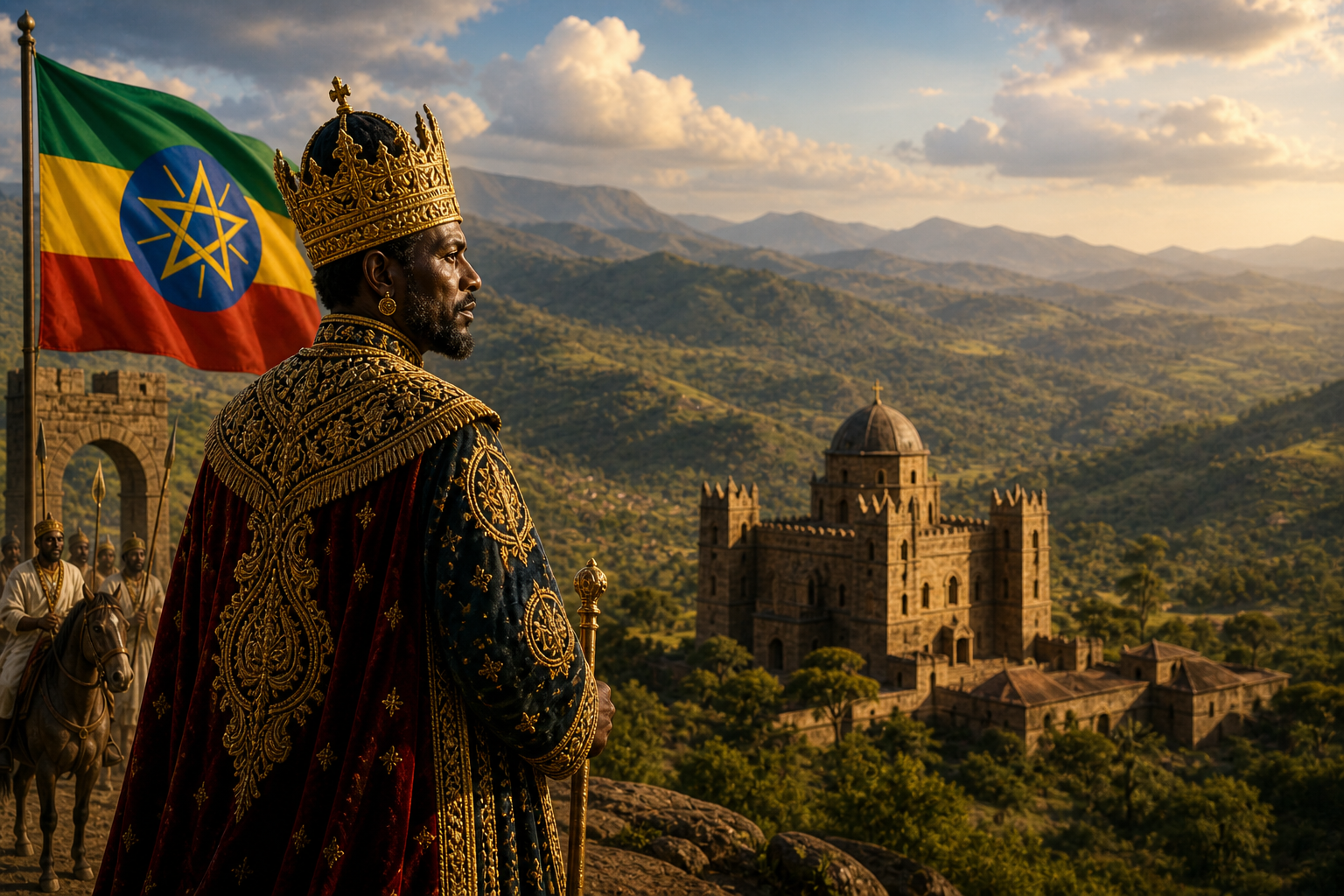
The Day the World Expected Ethiopia to Collapse
In 1896, European newspapers predicted an easy victory. A modern European army was marching into Africa. A centuries-old empire stood in its path. The outcome, they assumed, was obvious.
It wasn’t.
When the smoke cleared after the Battle of Adwa, the invading army had been defeated. Europe was stunned. Africa had witnessed something almost unheard of during the colonial era — an African empire had defended its sovereignty.
To understand how this was possible, we must travel back thousands of years — long before colonialism, long before modern borders — to the rise of one of the world’s oldest continuous civilizations: the Ethiopian Empire.
From Aksum to Empire: The Continuation of a Civilization
The Ethiopian Empire did not appear suddenly. It evolved from the legacy of the earlier Aksumite civilization. After Aksum’s decline around the 7th century, power shifted into the Ethiopian highlands.
Instead of disappearing, the civilization transformed and adapted.
This continuity is critical: Ethiopia represents one of the longest surviving state traditions in world history.
The Birth of the Solomonic Dynasty
In 1270, a new dynasty rose to power — the Solomonic Dynasty. Its rulers claimed descent from: King Solomon of Israel The Queen of Sheba Whether legend or political symbolism, this narrative provided powerful legitimacy. The emperor was known as the Negusa Nagast — King of Kings.
This was more than a title. It signified rule over a federation of kingdoms, nobles, and provinces across the Ethiopian highlands. The Peoples of the Ethiopian Empire The empire was never a single tribe or ethnic group.
It was a multi-ethnic highland civilization. Major groups included:
• Amhara
• Tigray
• Agaw
• Oromo (later integration)
• Gurage and others
This diversity required sophisticated governance and diplomacy.
Unity came from shared religion, monarchy, and culture — not uniform ethnicity.
A Unique System of Governance
The Ethiopian Empire functioned as a centralized monarchy with regional autonomy. The Emperor (Negusa Nagast)
The emperor was: • Supreme ruler • Commander of the army • Head of the church-state alliance • Final judge in legal matters
But governing a mountainous empire required delegation. Provincial Nobles Regional rulers governed provinces and paid tribute to the emperor.
They raised armies, collected taxes, and enforced law locally. This decentralized-centralized hybrid system allowed the empire to survive for centuries.
The Role of Religion in Governance
Christianity was central to Ethiopian identity. The Ethiopian Orthodox Church became a pillar of the state: • Education • Law • Cultural identity • Legitimacy of rulers
Monasteries preserved knowledge, literature, and art through centuries of global change. Religion unified the empire across language and ethnic lines.
Law and Justice in the Empire
Ethiopian law blended: • Customary African law • Christian moral codes • Royal decrees
Courts existed at multiple levels: Village elders → regional nobles → imperial court.
Justice emphasized: • Mediation • Compensation • Restoring social harmony
This mirrors legal traditions across East Africa.
Foreign Relations and Diplomacy
Ethiopia maintained diplomatic ties with: • Egypt • Portugal • Ottoman Empire • European kingdoms
This long history of diplomacy helped Ethiopia understand global politics better than many African states during the colonial era.
The Military Tradition
The empire maintained a strong warrior culture. Armies were raised by regional nobles and united under the emperor during war.
Key strengths: • Knowledge of mountainous terrain • Large mobilization capacity • Strong warrior traditions
These strengths proved decisive in the famous Battle of Adwa.
The Battle That Shocked the World
In 1896, Emperor Menelik II defeated Italy at Adwa.
This victory: • Preserved Ethiopian independence • Inspired anti-colonial movements • Made Ethiopia a global symbol of resistance
Ethiopia became one of the only African states to avoid long-term colonization.
How the Empire Treated Foreigners
Foreign traders and visitors were welcomed but regulated.
The empire balanced: • Trade opportunities • Cultural preservation • Political independence
This careful diplomacy helped Ethiopia modernize while maintaining sovereignty.
Economy and Trade
Economic foundations included: • Agriculture (teff, barley, coffee) • Livestock • Regional trade routes • Craft industries Coffee, originating from Ethiopia, later became a global commodity.
Why the Ethiopian Empire Survived for Millennia
Key reasons: • Strong monarchy • Religious unity • Geographic protection • Diplomatic awareness • Military resilience • Cultural continuity
Few civilizations can claim such longevity. Legacy of the Ethiopian Empire Today
Modern Ethiopia still reflects: • Ancient monarchy traditions • Orthodox Christianity • Unique language and script • Strong national identity
The empire’s influence continues to shape East Africa.
Why This Empire Matters
The Ethiopian Empire challenges the myth that African states lacked continuity.
Instead, it shows: • Long-term governance • Cultural resilience • Political sophistication
It stands as one of the world’s oldest surviving civilizations.


